Free DISC Personality Test
40 quick questions, about 6 minutes, and the full report is yours free: your style, your blend, your spot on the DISC wheel, and practical guidance for working with the other three.
I make decisions quickly and take responsibility for the outcome
I energize a room and get people talking to each other
I work at a steady, even pace rather than in bursts
I check my work carefully before anyone else sees it
I push hard for results, even when it ruffles feathers
What Your Free DISC Report Includes
Your report turns 40 answers into a clear read of how you work, communicate, and handle pressure. Six things you'll walk away knowing, and can put to use in your very next meeting.
Your primary DISC style
D, I, S, or C, explained in plain language. A memorable label for the pace you move at and where your attention goes first, so you can name your own patterns instead of just living inside them.
Your blend
Almost nobody is a pure style. If your second scale runs close to your first, your report names the blend (DI, SC, and so on) and describes how the two styles combine in practice.
Your place on the DISC wheel
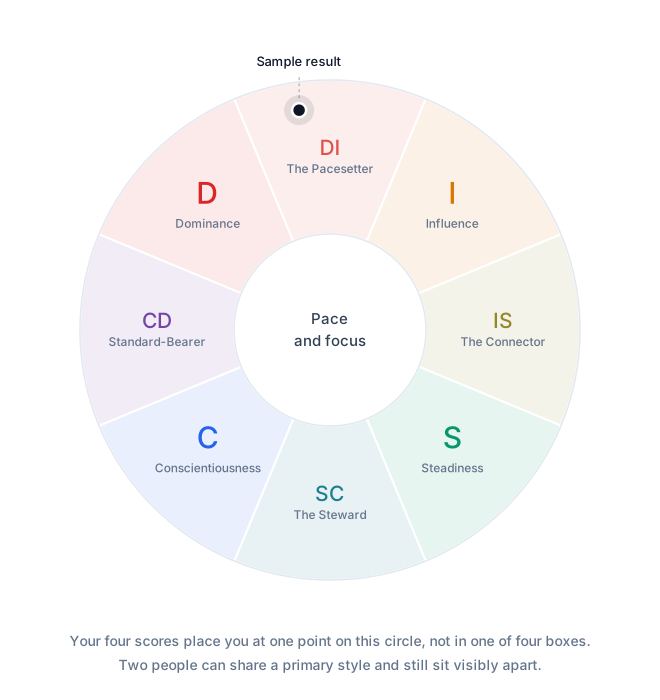
A dot on the wheel showing exactly where your mix of scores lands among the eight sectors. Two people can share a primary style and still sit in visibly different places.
Strengths and blind spots
What your style tends to do well, and where it tends to overreach. Practical, dignified, and honest. The kind of read you'd want from a thoughtful colleague, not a flattering horoscope.
Communication do's and don'ts
How to get through to each of the four styles, and what quietly shuts each one down. This is the section teams quote back to each other months later.
Work style and pressure patterns
The conditions where your style does its best work, what motivates and drains you, and how your behavior shifts when deadlines tighten and stakes rise.
A real preview
See a Sample DISC Report
This is a real report for one DI blend: the wheel, the style bars, and every tab, free to explore. Yours is built from your own answers, in the same depth, the moment you finish.
DI
The Pacesetter
DI blendYou walk into an unclear situation, find the decision nobody is making, and make it.
Your top two styles, Dominance and Influence, sit close together: you draw on both depending on the situation.
Take the free DISC assessmentYour dot marks where your four scores place you on the DISC wheel. Styles near yours share your pace and focus; styles across from yours are your natural complements.
Style breakdown
Your four styles
Where you sit on each of the four DISC work styles. All four are available to you; the profile shows which ones you reach for first.
Clear emphasis·You agreed with most of the Dominance statements. Deciding quickly and pushing for results are part of how you work, and people around you tend to see it.
Clear emphasis·You agreed with most of the Influence statements. Energy and optimism are part of how you work, and you move people through enthusiasm as much as through argument.
Mixed emphasis·Your Steadiness answers sat close to the middle of the scale. You offer patience and reliability when it matters, while staying open to shifts in pace and plan.
Mixed emphasis·Your Conscientiousness answers sat close to the middle of the scale. You apply rigor where the stakes demand it and let the rest move at a practical level of polish.
Scores are style strength out of 100, not percentiles: they show how strongly your answers leaned toward each style, not how you rank against other people.
What stands out about you
You would rather make a good decision today and repair it tomorrow than watch a perfect one die in review.
What this looks like in your life
Your default setting is forward. Where other people see a situation to discuss, you see a problem to close, and you are already halfway through the first move while the room is still framing the question. You measure days by what actually changed, not by what was talked about, and you have a low tolerance for the gap between the two. Obstacles read to you as information, not as verdicts. Being told something cannot be done is, for you, roughly the same experience as being handed the project.
What you prioritise
Your blend
DI · The Pacesetter
Your second style, Influence, sits close enough to your first that the two work as one pattern. Blends are common; this is yours.
You lead with results and bring people along on the way there. The Dominance side of you sets the terms: you decide quickly, speak plainly, and treat obstacles as scheduling problems rather than reasons to stop. But where a purely task-focused driver simply issues the goal, you sell it. You notice the room, you read who is with you and who is hesitating, and you put real energy into turning a plan into something people actually want to be part of. Momentum is your natural element. You are at your best in the opening stretch of anything: a launch, a turnaround, a negotiation, the first week of a project when the direction still needs someone to say it out loud and mean it.
Blend strengths
- ·Turns a goal into something people want to join, not just follow
- ·Decides fast and commits to the decision in public
- ·Stays energised under pressure and visibility
- ·Builds momentum a whole team can feel
Worth watching
- ·Enthusiasm in the room can be mistaken for genuine agreement
- ·Promises can run ahead of what the team can actually deliver
- ·Attention to detail fades once the exciting part is over
Your working style
You work in bursts of decisive motion. Give you a goal with real stakes and a visible finish line and you will organise everything else around it, recruiting help as you go. You think out loud, prefer short direct conversations to long documents, and handle setbacks by finding the next move rather than relitigating the last one. Meetings you run are fast and often enjoyable. What you need from a team is someone who owns the follow-through, because your energy naturally lives at the front of a project, and someone who will tell you plainly when the pace is costing accuracy.
DISC is a development and communication tool, not a selection instrument. Use it to understand working styles and talk about them well, never to screen, rank, or hire people.
Want this for your own style?
Six minutes of honest answers, and the report above becomes yours.
Take the free DISC assessmentHow This DISC Assessment Works
Answer 40 statements about how you naturally behave at work and in daily life. Your responses are scored across four scales, and the combination determines your style, your blend, and your position on the DISC wheel.
Start the test
Click Start and answer honestly. There are no right or wrong answers and no better or worse styles. Rate each statement by how well it describes you most of the time.
Answer 40 behavior items
Each item measures one of the four DISC scales. Items are balanced with forward and reverse scoring, and they describe everyday behavior rather than abstract traits.
See your 4-scale profile
Get a score on all four scales, not just a single label. The full profile matters: how high your second style runs tells you whether you are a pure style or a blend.
Get your style, blend, and wheel position
Your report names your primary style, identifies your blend when two scales run close, plots you on the DISC wheel, and gives you the complete profile free.
The 4 DISC Personality Types, and the 12 Blends
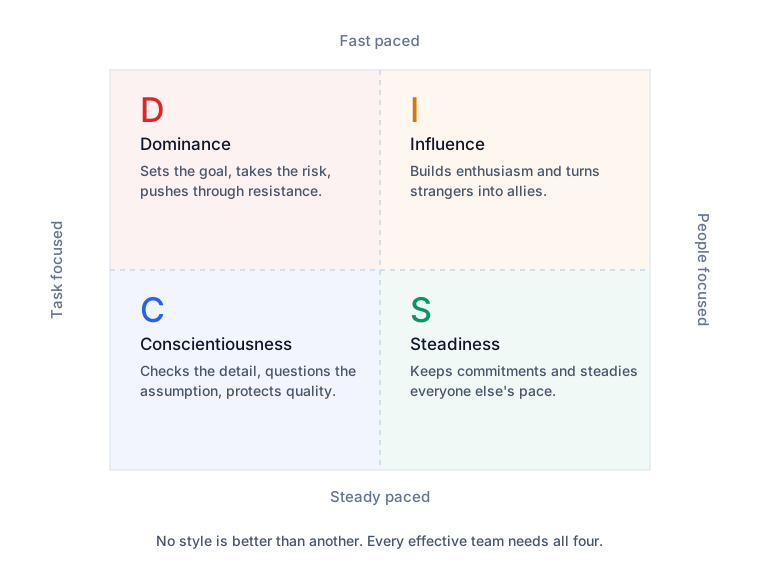
Each type is a distinct answer to two questions: how fast do you prefer to move, and does your attention go first to tasks or to people? No type is better than another, and every effective team needs all four.
Dominance (D)
Fast-paced and task-focused. Direct, decisive, and driven by results. D styles set the goal, take the risk, and push through resistance. They ask: what are we trying to win?
Influence (I)
Fast-paced and people-focused. Expressive, persuasive, and optimistic. I styles generate energy, build enthusiasm, and turn strangers into allies. They ask: who do we need on board?
Steadiness (S)
Steady-paced and people-focused. Patient, supportive, and consistent. S styles keep commitments, stabilize teams, and notice when someone is struggling. They ask: how do we keep this sustainable?
Conscientiousness (C)
Steady-paced and task-focused. Precise, analytical, and guided by standards. C styles check the details, question the assumptions, and protect quality. They ask: is this actually correct?
Why one letter is usually enough
D, I, S, C. The letters are a useful shorthand: easy to share, easy to remember, and accurate enough that most teams get real mileage from them inside a single conversation. Knowing that your colleague is an S and you are a D explains a remarkable amount of everyday friction. To see the whole group at once, run the DISC assessment for team building: every teammate takes this same test and the team map builds itself. To compare a team on five continuous traits instead of four styles, the free team personality test puts everyone's Big Five profile on one map.
Why the wheel adds precision
The four styles are not four boxes. They are four regions on a circle built from two axes: how fast you prefer to move, and whether your attention goes first to tasks or to people. Your answers place you at a point on that circle, which is why a DC near the task edge behaves differently from a DI leaning toward people, though both lead with D.
Expand any style for the short version of its full profile.
D · Dominance +
The D personality type leads with results. A high D walks into an unclear situation, finds the decision nobody is making, and makes it: direct, decisive, driven by outcomes rather than applause. Two strengths stand out. Decisiveness, meaning a high D can make a real call on incomplete information and stand behind it while others wait for a certainty that is not coming. And calm in a crisis: when something genuinely breaks, D styles get quieter and faster, and teams reorganize around them. The blind spot worth naming is impatience that reads as dismissal, because cutting a long explanation short saves minutes and quietly costs goodwill. Ds work well with C styles, whose rigor keeps their speed survivable, and with S colleagues, who finish what the D starts.
I · Influence +
The I personality type leads with people. A high I reads a room instantly, talks ideas into motion, and makes work feel like company. Two strengths stand out. Natural persuasion: when an I believes in a plan, the room starts believing with them, and ideas that would have died in a document live because someone spoke for them. And connecting people: an I holds a live map of who knows what, who needs whom, and who should have met months ago. The honest blind spot is that the finish is quieter than the start, as energy peaks while work is new and public, then thins as it turns routine. I styles pair well with S colleagues, who complete what they begin, and with C styles, whose checked figures make an I's best pitches safe to repeat.
S · Steadiness +
The S personality type leads with steadiness. A high S keeps commitments at a rate colleagues find effortful and they find obvious: patient, supportive, consistent, the calm center that makes everyone else's pace possible. Two strengths define the style. Reliability, where Thursday means Thursday, without drama and without reminders, compounding over years into a trust that cannot be fast-tracked. And deep listening: an S hears what people say and what they carefully do not, which makes them the truest barometer of team health anyone has. The blind spot to watch is deferred conflict, because the disagreement swallowed today comes back larger. S styles work well with D colleagues, supplying the finish a driver cannot get elsewhere, and with I styles, whose half-finished enthusiasm they quietly complete.
C · Conscientiousness +
The C personality type leads with the standard. A high C would rather be right slowly than wrong impressively: precise, analytical, and loyal first to whether a claim is actually correct. Two strengths carry the style. Analytical rigor, catching the contradiction three steps before it becomes expensive. And intellectual honesty: saying "I do not know" when it is true, flagging the weakness in their own work before a reviewer finds it, and changing position when the evidence turns. The blind spot is that perfect delays good, and the last five percent of polish can cost a third of the schedule while being invisible to everyone but them. C styles pair naturally with D colleagues, whose speed they make survivable, and with S styles, in the quiet partnership that produces the most reliable work in the building.
The 12 blends
When your second scale runs close to your first, you are a blend. The first letter leads; the second colors it. A DI is a driver who persuades, while an ID is a persuader who pushes.
Sets the goal first, then wins people to it. Persuasion in service of the result.
Decisive and exacting. Moves fast, but only on a case that holds up.
Direct about the destination, patient with the people carrying things there.
Leads with warmth and enthusiasm, and pushes without apology when the room stalls.
Sociable and loyal. Builds relationships quickly and keeps them for years.
Persuasive and precise. Checks the numbers before telling the story.
Steady first, social second. Quiet consistency with genuine warmth on top.
Calm and careful. A dependable pace paired with a quiet insistence on getting it right.
Patient by default, decisive when it counts. The steady hand that can still make the call.
Precise and considerate. High standards delivered gently, without the sharp edges.
Standards first, speed second. Analysis that ends in a decision, not a report.
Rigorous but expressive. Makes the careful answer easy for everyone to follow.
Your own report goes much deeper on whichever style and blend turn out to be yours.
A note on honesty: DISC is a language for behavior patterns, not a measurement of ability, values, or character. It describes how you tend to act, especially at work, and it does that well. Read it as a lens for self-understanding and communication, not a verdict on who you are.
More Free Personality Tests
Behavior style is one lens. These complementary tests give you a fuller picture, and every one of them is free.
Big Five Personality Test
The gold standard of personality science. 5 domains, 30 subfacets, and continuous trait scores with strong research support.
Personality Type Test
The classic 16-type framework. Find whether you're an Architect, Campaigner, or Defender, and how your type connects with others.
Enneagram Test
Nine types, wings, and instincts. A reflective framework for the motivations underneath your behavior, with the full report free.
Put everyone on one live team map: style mix, comfort zones and working norms.
the year Emotions of Normal People proposed the four styles
The Man Behind DISC Invented the Lie Detector
DISC is nearly a century old, and its origin story is stranger than most personality tests can claim.
In 1928, Harvard-trained psychologist William Moulton Marston proposed that people express four primary emotional responses to the world: dominance, inducement, submission, and compliance. Marston was not a man of narrow interests. He helped invent the lie detector, and he went on to create Wonder Woman. The one thing he never built was a test.
Industrial psychologists did that later, turning his framework into the workplace questionnaires used everywhere today, under friendlier names: Dominance, Influence, Steadiness, Conscientiousness. Our version keeps his model and modernises the measurement, with 40 original statements written the way people actually describe their behavior rather than the forced-choice word lists many older DISC tools still use.
Is the DISC Assessment Scientifically Valid?
It is a genuinely useful lens with real limits, and we would rather tell you both halves than sell you one.
The model holds up better than its reputation and worse than its marketing. Its two axes closely resemble the interpersonal circumplex, a model with a long history in academic psychology, and studies comparing four-quadrant tools with the Big Five find sensible overlap: D tracks assertiveness, I tracks sociability, S tracks patience and warmth, C tracks conscientiousness.
At the same time, DISC has far less peer-reviewed evidence behind it than the Big Five, it measures behavioral style rather than underlying traits, and most published validation comes from the companies that sell it. So here is the fair deal: use it for what it is brilliant at, and never for what it is not. For the validated trait picture, pair it with our free Big Five test.
Use DISC for
- A shared vocabulary your whole team actually remembers
- Naming everyday friction without blaming anyone
- Understanding your own default pace and focus
- Onboarding, coaching, and communication ground rules
Never use it for
- Screening or selecting job candidates
- Predicting how well someone will perform
- Measuring ability, intelligence, or character
- Any high-stakes decision about a person
Sources: Marston (1928) Wiggins (1979) McCrae & Costa (1989) Gurtman (2009) Jones & Hartley (2013)
DISC Personality Test FAQ
What does the DISC assessment measure? +
DISC measures your behavioral style along two axes: the pace you prefer to move at (fast and active vs steady and thoughtful) and where your attention goes first (tasks and results vs people and relationships). It does not measure intelligence, mental health, values, or ability. Think of it as a description of your default operating mode, especially at work: how you communicate, make decisions, handle conflict, and respond to pressure.
What are the four DISC personality styles? +
Dominance (D): direct, decisive, results-driven, comfortable with conflict and risk. Influence (I): expressive, persuasive, optimistic, energized by people and possibilities. Steadiness (S): patient, supportive, consistent, the stabilizing presence on a team. Conscientiousness (C): precise, analytical, quality-focused, guided by standards and evidence. Every style brings something a team needs, and none is better than another.
What is a DISC blend, and why do most people have one? +
Very few people score high on exactly one scale. When your second-highest scale runs close to your first, you have a blend, written as two letters with the stronger one first: DI, SC, CD, and so on. The first letter sets your core style and the second colors it. A DI leads with drive and persuades along the way; an ID leads with persuasion and pushes when needed. Our test reports your blend whenever your top two scales sit close together, which is the case for most people.
How is DISC different from the Big Five and MBTI? +
DISC describes behavior: how you tend to act, especially at work. The Big Five measures underlying personality traits on continuous scales and has the strongest research support of the three. MBTI-style type tests sort you into one of 16 types based on how you think and decide. In practice, DISC is the quickest to apply in team settings, the Big Five is the most scientifically validated, and 16-type frameworks are the most popular for self-discovery. They answer different questions, so many people take all three.
How do teams use DISC at work? +
Mostly as a shared vocabulary. Once a team knows who leads with D, I, S, or C, everyday friction gets easier to name and fix: the D who wants the summary first, the C who wants the data first, the S who needs time to process a change, the I who thinks out loud. Teams use DISC profiles for onboarding, communication ground rules, meeting design, and conflict conversations. Because our full report is free, an entire team can take it in one afternoon without a training budget. The DISC assessment for team building puts everyone on one live map, and its DISC team building activities are written to run against that map.
Is DISC valid for hiring decisions? +
We'll be honest even though it costs us: no, and you should be wary of anyone who says otherwise. DISC describes communication style, and the research base does not support using it to predict job performance or screen candidates. It shines after the hire: onboarding, team communication, coaching, and management. If you are assessing candidates, structured interviews and validated measures (such as Big Five conscientiousness or ability tests) have far stronger evidence behind them.
How long does the DISC test take? +
Most people finish the 40 questions in about 6 minutes. That is a little longer than the shortest DISC quizzes, and it is deliberate: 10 items per scale, balanced with reverse-keyed statements, gives each of your four scores enough answers behind it to be worth reading. There is no time limit, so take as long as you need. Your progress is saved automatically in your browser, and you can resume if you get interrupted.
Is this DISC assessment really free? +
Yes, the entire report: your style, your blend, your wheel position, communication guidance, strengths, blind spots, and pressure patterns. Certified DISC programs typically charge $60 to $100+ per person for a comparable profile, because the reports are sold through consultants and training workshops. Ours is free with no email, no account, and no paywalled sections. Your answers are processed in your browser, and you get a shareable link to your results.
Can I download or print my DISC profile as a PDF? +
Yes. Your results page prints straight from the browser, and there is a Save as PDF button on the report itself: press it, or use Ctrl+P, or Cmd+P on a Mac, and you have a downloadable copy of your profile with no account and no email. There is no paper questionnaire to print and score by hand, and that is deliberate: the assessment scores itself the moment you finish, and your position on the wheel is computed from all four scale scores, which is fiddly work to do with a pen.
Is my data private, and do you sell it? +
No, we do not sell your data, because we do not collect it. Your answers are scored in your browser and are never sent to a server, so there is nothing on our side to store, mine, or pass on. We do not ask for an email or an account to show you the full report. The one thing that travels is the shareable results link you get at the end, and it only goes anywhere if you decide to send it.
Can I save my DISC results and come back later? +
Yes. While you are answering, your progress saves automatically in your browser, so an interruption partway through the quiz costs you nothing. When you finish, you get a shareable results link, and that link is the permanent way back: bookmark it, send it to yourself, open it on any device, no login needed. Worth knowing: the in-progress save lives only in that browser, so clearing site data or switching device mid-test starts you over. The link is the part that lasts.
Will I get the same result if I retake the DISC assessment? +
Usually your primary style holds, while the finer detail moves. Behavioral style is reasonably stable, but it is also context sensitive: answering with your current job in mind after a rough week can shift a scale by a few points, which is enough to reorder a close second place and nudge your wheel position. We have not published a test-retest figure for SMP DISC Styles v1 yet, so we will not quote one. If two runs disagree, read both, and trust the pattern that shows up in your actual behavior.
What careers or roles suit my DISC style? +
Directionally: D styles gravitate to roles with decision rights and visible outcomes, I styles to work built on persuasion and people, S styles to roles where continuity and trust compound, and C styles to work judged on accuracy. Your report names a few specific roles that tend to fit. Read those as conditions you tend to enjoy, not jobs you are qualified for. DISC describes how you work, not what you are capable of, and every role has been done well by all four styles. For the fit question itself, our free career test matches your interests against real occupations.
Which DISC style is the most common, and which is the rarest? +
Nobody can answer that cleanly, including us. Published distributions vary a lot by instrument and sample: a corporate training population is not the general public. S and I are commonly reported as the more frequent primary styles, though the bigger point is that pure single-style profiles are uncommon, since most people are a blend, so the answer shifts with where you draw the line. We have not collected our own distribution yet, and will not borrow someone else's. Rarity says nothing about quality, and your own four scores tell you more than any ranking would.
About This Assessment
Instrument
SMP DISC Styles v1: 40 original items measuring the four DISC scales (Dominance, Influence, Steadiness, Conscientiousness), 10 items per scale, balanced with forward and reverse scoring. Items are modern normative Likert statements written by SeeMyPersonality and are not derived from any commercial DISC instrument.
How Scoring Works
Your responses are scored deterministically in your browser. Each scale produces a mean score; your primary style is the highest scale, a blend is reported when your second scale runs close behind, and your wheel position is computed from all four scores. No AI generates your result. It is calculated directly from your answers.
Written and reviewed by:
Michael Hodge, BSc Psychology, University of Wollongong. Founder of SeeMyPersonality, with coursework in psychometrics and research methods. Has built and run online personality measurement since 2003, wrote all 40 items in this assessment, and built the scoring that produces your style, your blend, and your position on the wheel. Research and review standards.
Conflicts of interest: None. Nothing on this page is sponsored, and no DISC publisher or training provider has any involvement in it.
This assessment is provided for self-reflection, communication, and professional development, not clinical diagnosis or personnel selection. DISC describes behavioral tendencies, and most people flex across styles depending on context.
Ready to find your DISC style?
The DISC assessment takes about 6 minutes. Your answers are completely private, processed in your browser, and never stored. No email required.
Want the more validated cousin? Take the free Big Five personality test alongside this one for the fuller trait picture. Running this with colleagues? A DISC assessment for team building puts everyone's style on one shared map.