Team charter template: download it, or build one in 15 minutes
A team charter is one page that records why a team exists, what it values, how it behaves, who holds what and how it decides. Take the blank template, start from a finished example, or fill in the builder below.
The builder
Build your team charter. Load an example, edit it, export Word or PDF.
Start from a preset, or from nothing. Everything stays editable.
1 The basics
The test of a good purpose line: would a stranger reading it know what your team should say no to?
2 Values pick 3 to 5
Hover a value to see the plain-language meaning it carries into the document.
3 Norms: how we work
Meetings
Communication
Decisions
Feedback
Five to eight is the sweet spot. Two norms your team keeps beat ten it admires.
4 Roles and responsibilities
One name per line. Shared ownership is how work gets orphaned politely.
5 How we decide
6 Meeting rhythm
Every standing meeting should be able to say what it is for in one phrase.
7 Success measures and review
Two or three measures are plenty. The review date is the difference between a document and a decoration.
Team charter
Your team
Your charter assembles itself here as you fill in the form. Start from a preset above if you want something to react to instead of a blank page.
Saved in your browser as you type. Nothing is uploaded, and nothing here needs an account.
Downloads
Team charter templates and examples, as Word and PDF
One blank template and four finished team charter examples. The Word files are fully editable; the PDFs print onto a single A4 or Letter page.
| Template | Written for | Word | |
|---|---|---|---|
| Blank team charter template | Any team. Eight prompts on one page, with room to write. | Download .docx | Download .pdf |
| Project team charter example | A cross-functional team formed around one deliverable and a real deadline. | Download .docx | Download .pdf |
| Remote team charter example | A distributed team that runs on writing, overlap hours and trust. | Download .docx | Download .pdf |
| Leadership team charter example | A senior team that decides together and speaks with one voice after. | Download .docx | Download .pdf |
| Startup founding team charter example | Two to four founders who need speed now and no resentment later. | Download .docx | Download .pdf |
Google Docs
Download the Word file, then in Google Docs choose File, Open, Upload. It becomes an editable Doc in your own Drive, with the headings, bullets and roles table intact. We do not host a shared Doc to copy: a file in your own Drive is one nobody else can change.
The short version
What is a team charter?
A team charter is the answers a team will eventually need, written down before anyone needs them: why we exist, what we protect, how we behave, who holds what, and how we decide when we disagree. One page, drafted by the team and signed by the people it describes. It also goes by team agreement, team contract and ways of working.
The alternative to a charter is not "no rules". Every team acquires working rules within weeks, set by precedent and by whoever spoke first. In a classic study of project teams, the approach each team fell into in its first meeting tended to persist to the project’s midpoint. A charter is the choice to set those defaults on purpose.
The honest read
In a semester-long study, teams that produced high-quality charters early sustained higher performance while similar teams faded. Most of this research is on student and project teams, and what predicted the result was the quality of the thinking, not the existence of a document. A template filled in to be filed does nothing. Sources are at the foot of the page.
What goes in a team charter template, section by section
| Section | What to write | Written like this |
|---|---|---|
| 1. Purpose | One or two sentences, written to exclude: the work, who it serves, and by implication what the team says no to. | We exist to migrate every customer to the new platform without breaking their week. |
| 2. Values | Three to five, each with a plain meaning attached. A real value is one you can name the cost of. | Candor: we say the hard thing early, kindly. |
| 3. Norms | Five to eight rules phrased as behaviour someone could witness, not virtues to aspire to. | We reply within one working day, even if only to say when. |
| 4. Roles | One line of responsibility per role, one name per line. Shared ownership reads as generous and works as orphaned. | Risk keeper: owns the risk list and says the uncomfortable thing early. |
| 5. Decision rule | The default way the team chooses: one owner, consent, consensus, a vote, or the lead. Most templates skip it and most teams need it first. | One owner decides, after hearing the team. |
| 6. Meeting rhythm | Every standing meeting, with its rhythm and its purpose in one phrase. | Friday review: 20 minutes, what shipped and what slipped. |
| 7. Measures and review | Two or three measures with a number or a date in them, a review date for the charter, and signatures. | Every customer migrated by 28 March, with zero data loss. |
Examples
Three team charter examples, in full. Steal the shapes, not the sentences.
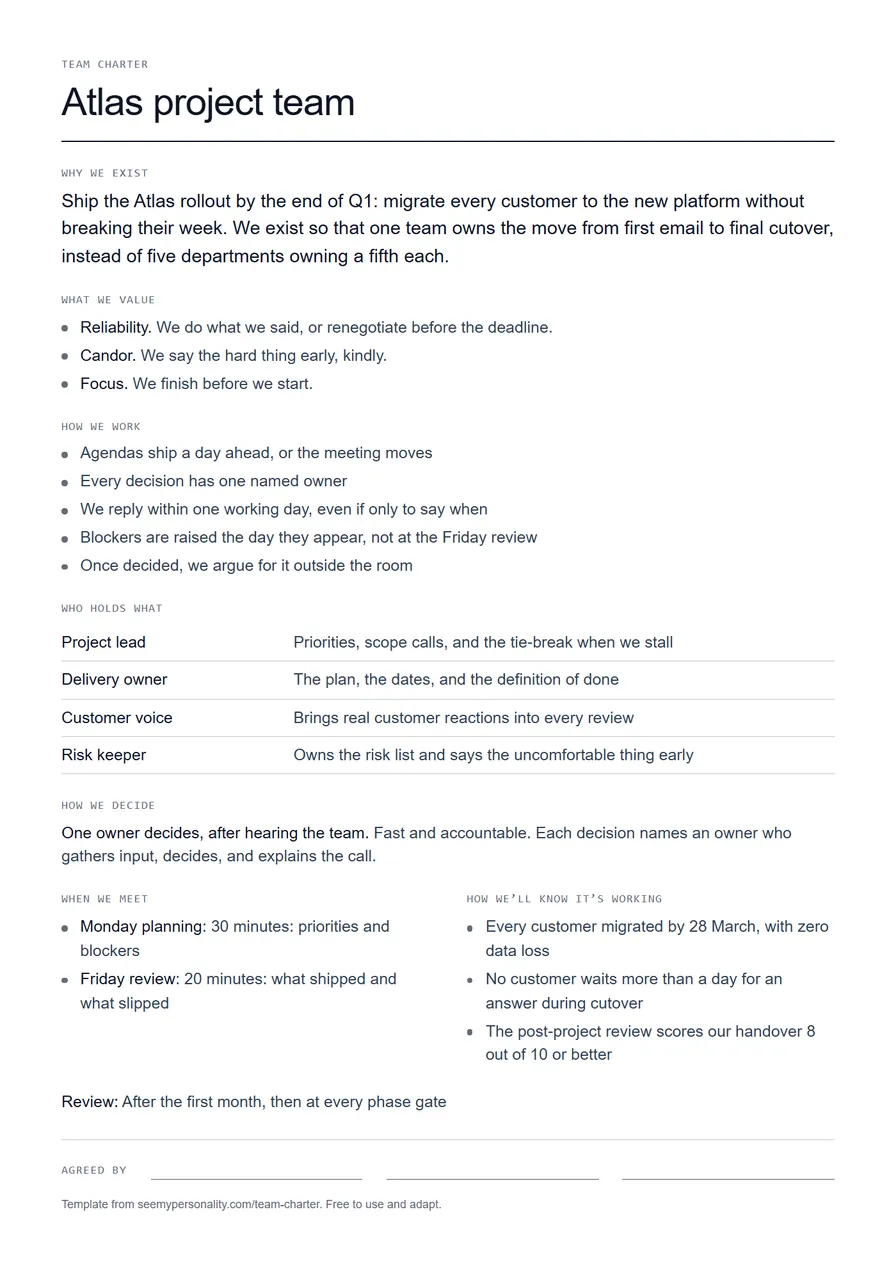
Team charter
Atlas project team
Why we exist
Ship the Atlas rollout by the end of Q1: migrate every customer to the new platform without breaking their week. We exist so that one team owns the move from first email to final cutover, instead of five departments owning a fifth each.
What we value
- Reliability. We do what we said, or renegotiate before the deadline.
- Candor. We say the hard thing early, kindly.
- Focus. We finish before we start.
How we work
- Agendas ship a day ahead, or the meeting moves
- Every decision has one named owner
- We reply within one working day, even if only to say when
- Blockers are raised the day they appear, not at the Friday review
- Once decided, we argue for it outside the room
Who holds what
| Project lead | Priorities, scope calls, and the tie-break when we stall |
| Delivery owner | The plan, the dates, and the definition of done |
| Customer voice | Brings real customer reactions into every review |
| Risk keeper | Owns the risk list and says the uncomfortable thing early |
How we decide
One owner decides, after hearing the team. Fast and accountable. Each decision names an owner who gathers input, decides, and explains the call.
When we meet
- Monday planning: 30 minutes: priorities and blockers
- Friday review: 20 minutes: what shipped and what slipped
How we'll know it's working
- Every customer migrated by 28 March, with zero data loss
- No customer waits more than a day for an answer during cutover
- The post-project review scores our handover 8 out of 10 or better
What to notice. The purpose names a date and a customer promise, so "done" is never a matter of opinion. Word · PDF
Team charter
Northwind remote team
Why we exist
Run customer support and success across four time zones without anyone working someone else's hours. We exist to make distance an advantage: round-the-clock coverage, written answers that outlive the conversation, and colleagues who trust each other without sharing an office.
What we value
- Trust. We assume good intent and check facts, not motives.
- Transparency. Decisions and reasons are visible by default.
- Calm. Urgency is a tool, not a climate.
How we work
- Decisions and reasons live in one written place
- Questions go to channels, not direct messages, so answers are shared
- Async first: a meeting is the escalation, not the default
- Core overlap is 2pm to 5pm UTC; outside it, no reply is expected
- Cameras optional, contribution not
Who holds what
| Team lead | Priorities, hiring, and the final call on policy |
| Docs keeper | Keeps the handbook current so answers stay findable |
| Handover editor | Makes the daily time-zone handover readable in two minutes |
How we decide
Consent: we proceed unless someone objects with a reason. Quick for reversible choices. An objection has to name the harm it prevents, not a preference.
When we meet
- Team call: Tuesdays, 45 minutes: the one meeting everyone attends
- Written weekly: Fridays, async thread: wins, worries, next week
How we'll know it's working
- First reply to any customer within four working hours
- The handbook answers 8 of 10 new questions without a meeting
- Nobody is scheduled outside their stated hours more than once a month
What to notice. Nearly every norm is about writing, because the hallway repair that fixes friction in an office does not exist across time zones. Word · PDF
Team charter
Foundry founding team
Why we exist
Find out whether anyone will pay for this before the money runs out. We exist to learn faster than we spend: build the smallest thing that tests the riskiest assumption, put it in front of real users weekly, and be honest about what we hear.
What we value
- Speed. We prefer a good decision today to a perfect one next month.
- Learning. We treat mistakes as tuition and share what they taught.
- Ownership. Every piece of work has one name on it.
How we work
- We ship something to a real user every week, however small
- Founder disagreements get 24 hours, then the owner of that area decides
- Bad news travels fastest: misses are shared the day we know
- We write down the assumption before we build the feature
- Equity, money, and workload get a standing monthly conversation, not a crisis one
Who holds what
| Product founder | What we build next, and what we say no to |
| Commercial founder | Users, revenue, and the runway maths |
| Technical founder | How it gets built, and which debt we accept |
How we decide
One owner decides, after hearing the team. Fast and accountable. Each decision names an owner who gathers input, decides, and explains the call.
When we meet
- Daily check: 10 minutes, async or standing: yesterday, today, stuck
- Weekly retro: Fridays, 30 minutes: what we learned, what we change
How we'll know it's working
- Ten paying customers by the end of the quarter
- Every feature traces back to an assumption it tested
- The runway number is reviewed monthly and never surprises us
What to notice. Equity, money and workload get a standing monthly slot before they are urgent, which makes the hard conversation routine. Word · PDF
A fourth sample, a leadership team charter with confidentiality and alignment norms, is in the downloads and in the builder.
Team norms
Team norms examples: 20 worth stealing
Team norms are the small, shared rules a team runs on: how meetings start, how disagreement is voiced, how fast a message deserves an answer. Writing them down does not add rules to a free team. It puts the rules that already run the team where everyone can see and change them.
Meetings
- Agendas ship a day ahead, or the meeting moves
- Meetings start on time and end five minutes early
- Every meeting closes with owners and dates read aloud
- No meeting without a decision to make or a plan to change
- Cameras optional, contribution not
Communication
- Questions go to channels, not direct messages, so answers are shared
- We reply within one working day, even if only to say when
- Disagreement arrives with a proposal attached
- Urgent means today; everything else gets a date
- Bad news travels fastest
Decisions
- Every decision has one named owner
- Reversible calls get a day, expensive ones get a week
- Once decided, we argue for it outside the room
- Decisions and reasons live in one written place
- Silence is not agreement; we ask the quiet person directly
Feedback
- Feedback goes to the person before it goes about them
- We praise in public and correct in private
- Retros end with one thing we stop doing
- Anyone can call a process check when a norm slips
- We thank the messenger, especially for bad news
What makes a good team norm
Four properties, in the order they usually go missing. Observable: a new member could tell within a week whether the team keeps it. Small: it governs a moment, not a mindset. Invokable: someone can call it mid-meeting without a speech. Autobiographical: it answers a friction this team has actually had. Take four or five from the list and add one norm nobody else would need.
Three terms, one relationship
Team charter vs working agreement vs team norms
A team working agreement is the norms section of a charter grown into its own document; the term comes from agile practice. The charter is the umbrella. Norms are the lines inside either. If you are unsure which you need, write the charter: it contains the agreement.
| Document | What it covers | Length | When it is the right tool |
|---|---|---|---|
| Team charter | Purpose, values, norms, roles, decision rule, meeting rhythm, measures | One page | New teams, cross-functional teams, and any team inheriting ambiguity |
| Working agreement | Norms only, in day-to-day detail: meetings, messages, feedback | Half a page | Stable teams whose purpose, roles and decision rule are already shared |
| Team norms | The individual behavioural rules inside either document | One line each | Always. Norms are the unit both documents are made of |
One hour, the whole team
How to run the team charter meeting
Put the builder or the blank template on a shared screen. Every step opens with a line you can read aloud. The antidote to an hour of polite nodding is silent writing before each discussion.
| From | Step | Say this |
|---|---|---|
| 0:00 | Set the frame | We are writing down how we will work so we never have to argue about it mid-crisis. Everything today is a version one, and we review it in a month. |
| 0:05 | Purpose: one sentence, argued | Two minutes each, silently: finish the sentence "This team exists so that...". Then we argue the versions into one. |
| 0:15 | Values: pick three to five | A value counts only if we can name the day it would cost us something. Which of these would we keep on a bad week? |
| 0:25 | Norms: start from friction | What happened in the last month that a shared rule would have made cheaper? We write five to eight norms that answer those moments. |
| 0:40 | Roles and the decision rule | For each recurring piece of work: who owns it, in one line? And when we disagree, what happens by default? |
| 0:50 | Measures and the review date | How will a stranger know in three months whether this team is working? Which date are we reviewing this? |
| 0:55 | Read it aloud and sign | If a line makes anyone wince, we cut it now. Whatever survives the reading is the charter. |
For 45 minutes, give purpose five minutes and fold the measures into the closing read. Remote teams: do every silent-writing round in chat, posting at the same moment, so nobody anchors on the first voice.
Before the meeting
The charter says how you will work. A team map shows who you are working with.
A charter records the behaviour a team is choosing. Personality is the behaviour each member would default to anyway, and the distance between the two is what a norm costs. A team of natural talkers needs airtime norms more than "speak up in meetings"; a team with no natural finisher needs two hard delivery norms, not six aspirational ones.
To see that before you write, run the free team personality test (five minutes each, one live map), or the five-minute team roles test if the question is who does what.
Common questions
Team charter template: questions people ask
What is a team charter?
A team charter is a short, shared document that records a team’s purpose, values, norms, roles and how decisions get made. Teams write it together at the start of their work and revisit it when something changes. Its value is less the paper than the argument: agreeing the answers out loud before pressure arrives.
What should a team charter template include?
Seven sections cover almost every team: purpose, values, norms, roles and responsibilities, a decision rule, meeting rhythm, and success measures, plus a review date and signatures. If you only have time for three, write the purpose, the norms and the decision rule. Those are the ones teams fight about later.
How do I open the team charter template in Google Docs?
Download the Word (.docx) file, open Google Docs, choose File, then Open, then Upload, and select the file. Google converts it into an editable Doc in your own Drive with the headings, bullets and roles table intact. We do not publish a shared Google Doc to copy, because a file in your own Drive is one nobody else can change.
Is the team charter template free to use?
Yes. The Word and PDF files, the four examples and the builder are free, need no account, and can be adapted for your own team, class or client work. The builder runs in your browser and saves your draft only on your device.
What is the difference between a team charter and a working agreement?
A working agreement is the norms section of a charter grown into its own document, and the term is most common on agile teams. It covers how people treat each other day to day. A charter adds purpose, roles, the decision rule and measures. Stable teams often need only the agreement; new or cross-functional teams benefit from the full charter.
How long should a team charter be?
One page. A charter earns its keep by being read, quoted and pointed at during disagreements, and nobody quotes page four. If yours is growing, move detail into linked documents and keep the charter as the index: one purpose sentence, three to five values, five to eight norms, one decision rule.
Who writes the team charter?
The team writes it together; one person may hold the pen, but not the answers. A leader-written charter reads as policy and collects polite nods. The research on charters comes from teams that built them jointly, and the shared argument appears to be most of the mechanism.
When should a team write its charter, and how often should it be reviewed?
Write it within the first week or two of working together: research on project teams found that the patterns set in a first meeting tend to persist to the project’s midpoint. Review it after the first month, then quarterly, and whenever membership or mission changes. A review takes fifteen minutes: which line earned its place, which line nobody used, what needs adding.
What makes a good team norm?
A good team norm is observable, small and phrased as a behaviour. "We reply within one working day" can be seen and invoked; "we communicate well" can only be nodded at. The test: could a new member tell, within a week, whether the team actually keeps it?
Do team charters actually improve performance?
The evidence is moderate. In a semester-long study of project teams, those with high-quality charters and performance strategies sustained higher performance while similar teams declined, and later studies found better teamwork behaviours. Most of this research is on student and project teams, so treat a charter as a well-supported bet with a cheap downside, and note that quality predicted the result, not the existence of a document.
Keep reading
More for teams
About this page
Michael Hodge, founder of SeeMyPersonality (BSc Psychology, University of Wollongong), wrote the template, the four examples and the builder against the studies listed below. More about the author.
Sources and further reading (7)
- Mathieu, J. E. & Rapp, T. L. (2009). Laying the foundation for successful team performance trajectories: the roles of team charters and performance strategies. Journal of Applied Psychology.
- Aaron, J. R., McDowell, W. C. & Herdman, A. O. (2014). The effects of a team charter on student team behaviors. Journal of Education for Business.
- Sverdrup, T. E. & Schei, V. (2015). "Cut me some slack": the psychological contract as a foundation for understanding team charters. The Journal of Applied Behavioral Science.
- Gersick, C. J. G. (1988). Time and transition in work teams: toward a new model of group development. Academy of Management Journal.
- Feldman, D. C. (1984). The development and enforcement of group norms. Academy of Management Review.
- Hackman, J. R. (2002). Leading Teams: Setting the Stage for Great Performances. Harvard Business School Press.
- Google re:Work (2016). Guide: understand team effectiveness (Project Aristotle).
Start here
An hour of arguing that replaces a year of guessing.
Take the template into the meeting, and let the document be wrong out loud, where it can be fixed.