Free Enneagram Test
Find your core type among the nine, then go further: your wing, your dominant instinct, and how your pattern shifts under stress and in growth. Full report included, free, no email.
A voice in my head points out what could be done better, including in myself
I sense what other people need before they say anything
I measure my worth largely by what I accomplish
I have a persistent sense that something essential is missing from my life
I need to understand something thoroughly before I feel ready to act
What you'll get
Your report turns 75 answers into a clear read of what drives you, not just how you act. Six things you'll walk away knowing, and can put to work this week.
Your core type
One of the nine types, named and explained: the core desire that pulls you forward, the core fear that nags underneath, and the attention pattern that quietly organizes your days. You also see your scores across all nine, so you know how clear the result is.
Your wing
Nobody is a type in isolation. Your wing is the stronger of your two neighboring types, and it flavors how your core pattern shows up. A 4w3 and a 4w5 share the same center of gravity but move through the world quite differently.
Your dominant instinct
Whether self-preservation, social belonging, or one-to-one intensity takes the front seat in your life. Many people find the instinct result lands harder than the type itself, because it explains what you reach for first when things get uncertain.
Your growth and stress arrows
Each type borrows traits from two others: one when you are secure and stretching, one when you are strained. Knowing your arrows helps you recognize an off week as a pattern rather than a personal failing.
Strengths and blind spots
What your type tends to do well, and where the same strength tends to overreach. Practical, dignified, and honest, the kind of read you'd want from a thoughtful friend rather than a flattering horoscope.
A Big Five cross-check
How your Enneagram type tends to map onto the Big Five trait model, the framework with the strongest research base. We show the echo between the two so you can hold your type result with appropriate confidence.
A real preview
See what your Enneagram report actually looks like
Below is the full report for a Type 4 with a 5 wing and a one-to-one instinct, every tab and every section, nothing abbreviated. Yours will be built from your own answers in the same depth and shape.
Type 4
The Individualist
You experience your own life at a depth most people only visit, and you have never quite believed the ordinary was meant for you.
Take the free Enneagram test for your own reportType breakdown
All nine types
Everyone carries traces of all nine patterns; one usually leads. These bars show how strongly you endorsed each type's core motivation. The gap between your top two matters more than any single number.
Your runner-up
Type 5 came second
Even a clear result deserves one honest check, because neighbouring patterns share surface habits. The fastest discriminator is the core fear: two types can do the same things for opposite reasons. Read both below, and if the second one lands harder, sit with the two for a week before settling.
Type 4 · Individualist
85Core fear
That you have no stable identity underneath the moods, no significance that would survive being truly seen. That you are, at the root, defective in a way other people simply are not.
Type 5 · Investigator
73Core fear
That the world’s demands will exceed what you have: that you will be depleted, intruded upon, or exposed as helpless in an arena you have not mastered.
What stands out about you
The sense that something essential is missing is not evidence that it is. It is the lens you were issued, and lenses can be worked with.
What this looks like in your life
There is a texture to your inner life that you noticed early and have been trying to put into words ever since. Where other people seem to move through their days on a kind of factory-default setting, you register the undertone of every room, the melancholy inside a happy song, the exact shade of difference between what someone said and what they meant. This is not a mood. It is a way of paying attention, and it makes you the person who names what everyone else was feeling but could not locate. The cost is a running comparison that rarely lands in your favour: other people seem to have been handed something, some ease or belonging or settled sense of self, that you suspect went missing from your delivery.
The engine underneath is a search for identity that actually holds. You would rather be genuinely known and slightly difficult than smoothly liked and interchangeable, and you can smell inauthenticity, in yourself most of all, from across a room. When this pattern is working for you, it produces work and relationships with a signature no one else could fake. When it is working against you, it turns longing into a residence: you live at a slight distance from your own life, waiting to become the person who can finally start it. The move that changes everything is small and unglamorous, which is exactly why it is hard for you: showing up for the ordinary day as if it already counted.
The Enneagram is a reflective framework, not a clinical measurement. Research on it is mixed, so treat this report as a well-organised mirror for self-observation, not a verdict on who you are.
Your strengths
Where you stand out
The qualities your type brings more reliably than most, the ones the people around you probably count on without ever naming. Every one of them has an overreach; the altitude check on the What Drives You tab shows what each looks like under strain.
Emotional depth
You can stay present with feelings, your own and other people’s, that would send most people scrambling for a distraction. In grief, in shame, in the complicated middle of things, you are the one who does not flinch.
An instinct for the authentic
You detect the false note in a sentence, a brand, or a person almost before it lands. This makes your approval slow to earn and genuinely worth something once given.
Aesthetic intelligence
Beauty is not decoration to you; it is information. You know why one word, one object, one arrangement of a room is right and its near-identical neighbour is wrong, and you can build atmospheres other people can only stand inside.
Original vision
Because you refuse the pre-made version of anything, what you make carries a signature. Your work may take longer to arrive, but it does not resemble anyone else’s.
Courage in dark rooms
When someone’s life falls apart, you do not offer a silver lining; you sit down in the wreckage next to them. People remember who could bear their worst hour, and it is very often you.
Self-knowledge
You have spent years in honest, sometimes ruthless conversation with your own interior. Little that surfaces in you goes unexamined, which gives you a head start on the work most people never begin.
Want this for your own type?
Take the free Enneagram test, about ten minutes, and read your own version of the report above: your type, your wing, your instinct.
Take the free Enneagram test for your own reportNine types, eighteen wings, three instincts
Most people meet the Enneagram through its nine numbered types, and that is a fine place to start. The framework has two more layers, wings and instincts, and they are where a good result starts feeling personal.
Why the nine types come first
Each type is built around a motivation, not a set of behaviors. Two people can both be organized, for example, but a One tidies because an inner critic points out what could be better, while a Three tidies because the room reflects on them. The Enneagram asks why you do what you do, which is what makes it feel less like a label and more like being noticed.
Why wings and instincts matter
Your wing is the stronger of your two neighboring types, and it shades your core pattern: a 9w8 holds ground more firmly than a 9w1. Your dominant instinct, self-preservation, social, or one-to-one, decides where your type's energy gets spent. Together they explain why two people of the same type can look strikingly different in practice.
The nine types
One line each, in plain language. No jargon, no rankings.
Hears a quiet inner editor pointing out what could be better, starting with themselves.
Senses what someone needs before they say it, and finds it hard to name their own needs.
Reads every room for what success looks like there, and quietly becomes it.
Carries a persistent sense that something essential is missing, and makes meaning from it.
Guards time and energy carefully, and prefers to understand a thing before entering it.
Scans for what could go wrong so the people they trust never have to.
Keeps the future stocked with plans and possibilities, partly for joy, partly as an exit.
Moves toward confrontation others avoid, and protects anyone in their circle.
Merges with the moods and agendas around them, and can lose their own in the process.
The three instincts
Whichever leads decides where your type's attention actually goes.
Attends first to comfort, security, health, and resources: is my base covered?
Attends first to groups, roles, and belonging: where do I stand with these people?
Attends first to intensity and chemistry with specific people: who truly draws me?
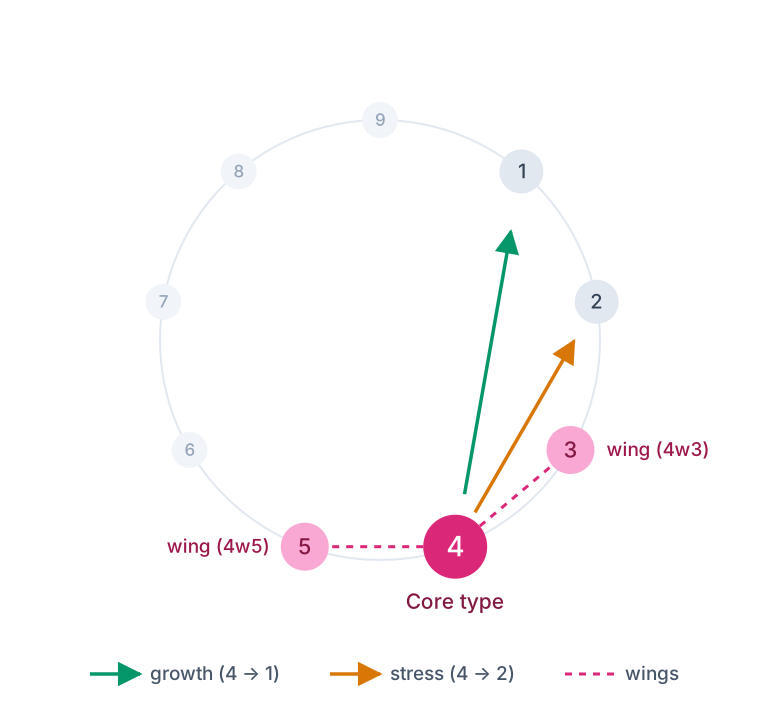
There is one more layer: the arrows. In growth, each type borrows the healthiest qualities of another (a One relaxes toward Seven's spontaneity); under stress, it slides toward a different one (a One picks up Four's moodiness). Your report maps both directions for your type.
Your free report names your core type, your wing, and your dominant instinct, then shows how the three combine in an ordinary week: at work, in close relationships, and under pressure.
A note on honesty: the type descriptions have some research behind them, but wings, instincts, and arrows are interpretive theory with little empirical support so far. They are useful for self-understanding. Read them as a lens, not a verdict.
How This Enneagram Test Works
Answer 75 statements about what drives you. Your responses are scored across nine type scales and three instinct scales, and the pattern determines your result.
Start the test
Click Start and answer honestly. There are no right or wrong answers, and no type is better than another. Rate each statement by how true it is of you, not how you wish it were.
Answer 75 motivation-focused items
Seven items per type and four per instinct, with reverse-keyed items mixed in to keep the scoring balanced. The items ask about fears, desires, and attention patterns rather than surface habits.
Get your full nine-type profile
See your score on every type, not just the winner. If your top two types are close, your report shows a comparison panel so you can verify which one actually fits.
Discover your type, wing, and instinct
Your highest type becomes your core type, your stronger neighbor becomes your wing, and your leading instinct completes the picture, along with your growth and stress arrows.
How the Enneagram Is Organized
The nine types cluster into three centers, each built around a core emotion. A fourth layer, the instincts, runs across all nine types.
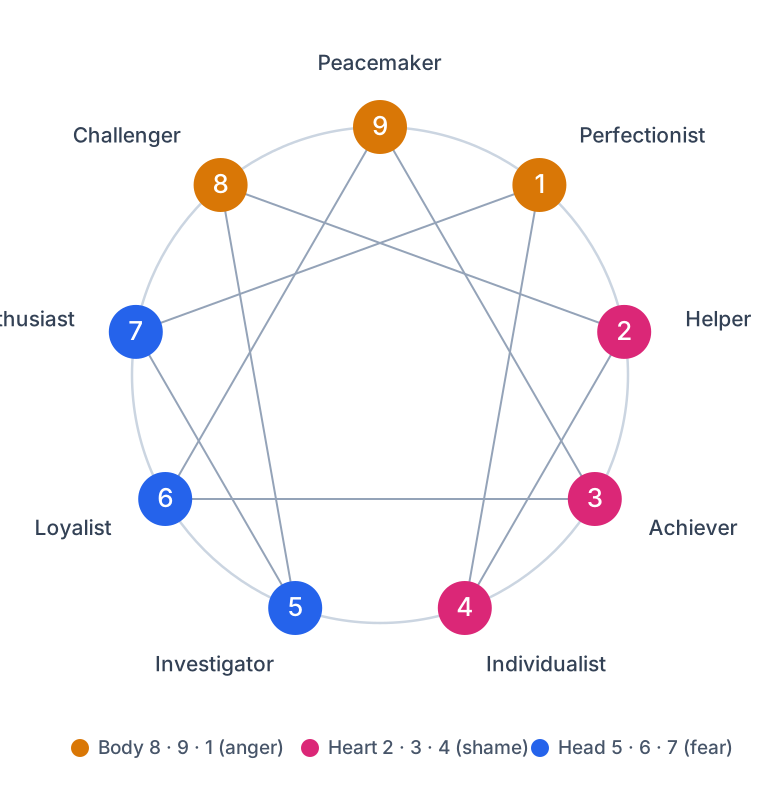
The Body Center (Types 8, 9, 1)
The gut types. Their core emotion is anger: expressed outward by Eights, kept asleep by Nines, and turned into self-correction by Ones. They know things first in their body, as a felt yes or no.
The Heart Center (Types 2, 3, 4)
The image types. Their core emotion is shame: managed by helping in Twos, outrun by achieving in Threes, and made into identity by Fours. They track how they are seen, and by whom.
The Head Center (Types 5, 6, 7)
The thinking types. Their core emotion is fear: met with knowledge by Fives, with vigilance by Sixes, and with options by Sevens. They prepare for the future because it feels safer understood.
The Three Instincts (sp, so, sx)
Self-preservation, social, and one-to-one. Whichever instinct dominates decides where your type's energy is spent, which is why two people of the same type can live noticeably different lives.
The Nine Enneagram Types
Your test result will identify one of these nine types. Each has its own motivation, wing variations, growth path, and stress pattern.
1 · The Perfectionist
Hears a quiet inner editor pointing out what could be better, starting with themselves.
2 · The Helper
Senses what someone needs before they say it, and finds it hard to name their own needs.
3 · The Achiever
Reads every room for what success looks like there, and quietly becomes it.
4 · The Individualist
Carries a persistent sense that something essential is missing, and makes meaning from it.
5 · The Investigator
Guards time and energy carefully, and prefers to understand a thing before entering it.
6 · The Loyalist
Scans for what could go wrong so the people they trust never have to.
7 · The Enthusiast
Keeps the future stocked with plans and possibilities, partly for joy, partly as an exit.
8 · The Challenger
Moves toward confrontation others avoid, and protects anyone in their circle.
9 · The Peacemaker
Merges with the moods and agendas around them, and can lose their own in the process.
Read a fuller summary of each of the 9 types below
Live data
Which types are most common on this test?
The share of each core type among the first test-takers here, one result per visitor. This is a snapshot of who takes Enneagram tests, not of humanity: the sample is young and self-selected, and we will update it as it grows.
First ~350 results, August 2026.
A Closer Look at Each Type
Each summary below is written to the person who has the type. Read your own as a mirror, and the other eight as a translation guide for the people around you. Every type expands into two wing variations, both described in full here.
Type 1 · The Perfectionist +
You carry a quiet conviction that things could be better than they are, and an even quieter suspicion that it falls to you to prove it.
Core fear: Being wrong at the core. Not making a mistake so much as being one: corrupt, careless, defective in a way that no amount of effort could repair.
Core desire: To be good and to know it. To have integrity that would hold up under any honest inspection, including your own, which is by far the strictest.
Where attention goes: Your attention goes straight to the gap between how things are and how they ought to be. In a room, a sentence, or a person, you register the flaw before you register anything else, and you feel a physical pull to correct it.
The two wings: Every Type 1 leans toward one neighbor: 1w9 (The Idealist) or 1w2 (The Advocate). Both are described below, and your report identifies which wing is stronger for you.
1w9 · The Idealist: With a Nine wing, your reforming instinct comes wrapped in calm. You hold your standards at a slight distance from the people around you: fewer corrections spoken aloud, more measured judgment, a preference for improving things through steady example rather than confrontation. You pick your battles carefully and often win them precisely because you waited. The Nine wing lends you patience, perspective, and a tolerance for imperfection in others that softens the sharper edges of the type. It also gives you somewhere to hide. When holding the standard would mean open conflict, this wing lets you withdraw into silent disapproval instead, keeping the verdict but skipping the conversation, and the people close to you can feel judged by someone who never actually said anything. Your growth as a 1w9 usually means saying the criticism out loud, kindly and early, rather than letting it calcify into distance.
1w2 · The Advocate: With a Two wing, your standards point outward, toward people. You do not just want things done right, you want them done right for someone: the student who deserves better teaching, the patient who deserves straighter answers, the team that deserves a fair process. This is the warmer, more visible face of the type, quick to mentor, quick to volunteer, genuinely energised by being useful. The Two wing gives you persuasive heat that a pure One rarely has; you can move a room, not just correct it. The tension is that your helping and your judging use the same eyes. The people you serve hardest are also the ones whose flaws you see in the highest resolution, and correction can arrive wearing the costume of care. Your growth as a 1w2 usually means asking whether the improvement you are offering was requested, and letting people be helped in the way they actually wanted.
Type 2 · The Helper +
You read the needs of a room the way other people read its temperature, and you have been meeting them since before you could name your own.
Core fear: Being unwanted. Not disliked exactly, but dispensable: the discovery that if you stopped giving, the people you love would have no remaining reason to keep you close.
Core desire: To be loved for yourself, freely and without invoice. To hear someone say they would want you around even if you never lifted a finger again, and to actually believe them.
Where attention goes: Your attention goes to other people’s needs, moods, and unspoken wishes, and to your own standing in their affections. What rarely makes it onto the radar screen is what you yourself are feeling and needing right now.
The two wings: Every Type 2 leans toward one neighbor: 2w1 (The Caretaker) or 2w3 (The Host). Both are described below, and your report identifies which wing is stronger for you.
2w1 · The Caretaker: With a One wing, your giving acquires a spine of principle. You help because it is right, not only because it connects, and there is a quieter, more dutiful cast to your care: reliable rather than showy, boundaried rather than boundless, often expressed through service to institutions, congregations, wards, and causes as much as to individuals. People experience you as trustworthy in a deep, old-fashioned sense; you keep confidences, you keep commitments, and your warmth never feels like flattery. The One wing also imports its critic. You judge your own giving, worrying whether you helped enough or helped correctly, and you can turn subtly disapproving when the people you serve make choices you consider unwise. Your growth as a 2w1 usually means letting care stay warm even when it cannot approve, and noticing when duty has crowded out the simple pleasure of connection that drew you to people in the first place.
2w3 · The Host: With a Three wing, your warmth gains wattage. You do not just care for people, you delight them: the memorable dinner, the perfectly chosen gift, the introduction that changes someone’s career. You are socially gifted, energetic, and aware of your effect on a room in a way the quieter wing is not; being adored is not incidental to you, it is part of the design. This wing makes you formidable in any people business, because you combine genuine attunement with an instinct for presentation. The tension is that image starts negotiating with intimacy. You can find yourself performing the role of the generous one, curating how your care is seen, and measuring your worth in gratitude received per gesture given. Your growth as a 2w3 usually means letting someone see you unpolished and needy, and discovering that the connection survives without the production values.
Type 3 · The Achiever +
You can become whatever the situation requires, brilliantly, and the question that waits underneath is who you are when nothing is required at all.
Core fear: Being worthless apart from what you produce. That if the achievements were subtracted, the deals, the titles, the transformations, there would be nothing left that anyone would stay for.
Core desire: To be valuable, and to have that value recognised. In its deepest register: to be loved for who you are, before and beneath anything you have done.
Where attention goes: Your attention goes to goals, tasks, and the fastest workable route between them, and simultaneously to your audience: what this room admires, how you are landing, and what small adjustment would land better.
The two wings: Every Type 3 leans toward one neighbor: 3w2 (The Charmer) or 3w4 (The Professional). Both are described below, and your report identifies which wing is stronger for you.
3w2 · The Charmer: With a Two wing, your achievement runs through people. You are the star who remembers names, the closer who makes the client feel like the only account in the book, the leader whose team feels personally invested in rather than managed. Warmth is not a tactic here; you genuinely light up in connection, and much of what you achieve, you achieve for and through relationships. Colleagues and audiences adore you, and being adored is, if you are honest, part of the fuel. The tension is that approval becomes a second scoreboard. You can find yourself editing opinions to keep the room warm, promising more than any calendar could hold, and feeling a disproportionate sting when admiration cools. Your growth as a 3w2 usually means disappointing someone on purpose, kindly, and noticing that both you and the relationship survive it: the charm is a gift, but it was never the price of admission.
3w4 · The Professional: With a Four wing, your ambition turns inward toward craft and meaning. It is not enough to win; the work has to be good, distinctive, and recognisably yours, and you would rather build one exceptional thing than ten adequate ones. This wing gives you depth the type is rarely credited with: introspection, aesthetic judgment, an allergy to the generic, and a private emotional life that the polished exterior does not advertise. You are drawn to mastery over popularity, the respected specialist rather than the crowd favourite. The tension is that image and authenticity negotiate constantly. You want to be seen as substantive, which is still a way of being seen, and the Four wing’s undertow of self-doubt can make achievements feel like they belong to the persona rather than to you. Your growth as a 3w4 usually means showing work before it is perfect, and letting the unfinished version of you meet an audience.
Type 4 · The Individualist +
You experience your own life at a depth most people only visit, and you have never quite believed the ordinary was meant for you.
Core fear: That you have no stable identity underneath the moods, no significance that would survive being truly seen. That you are, at the root, defective in a way other people simply are not.
Core desire: To find and express who you actually are, and to have that self matter to someone. Not to be admired in general, but to be recognised in particular.
Where attention goes: Your attention moves toward what is absent: the missing piece, the distant ideal, the way things could have been. Comparison runs constantly in the background, and the far-away tends to glow brighter than whatever is in your hands.
The two wings: Every Type 4 leans toward one neighbor: 4w3 (The Stylist) or 4w5 (The Solitary Poet). Both are described below, and your report identifies which wing is stronger for you.
4w3 · The Stylist: With a Three wing, your depth wants an audience, and it tends to earn one. You share the Four’s inner intensity, but the Three influence adds ambition, social fluency, and a real instinct for presentation: the feeling becomes a finished piece, the taste becomes a portfolio, the identity becomes something you can actually ship. You are likelier than other Fours to turn longing into output, to meet deadlines, and to care how the work lands. The friction point is that image-awareness can start editing the authenticity you prize. You may catch yourself curating your uniqueness, performing depth rather than living it, or measuring your inner life by its reception. The growth move for a 4w3 is letting something you made be seen before it is perfect, and letting something you feel stay private without concluding it was wasted.
4w5 · The Solitary Poet: With a Five wing, the intensity turns inward and gets quieter. You share the Four’s emotional depth, but the Five influence adds a cerebral, private, almost austere cast: you would rather understand a feeling completely than display it at all, and you need more solitude than almost anyone in your life fully grasps. Your inner world is enormous, intricate, and largely unexported. This wing tends to produce genuinely original thinkers and makers, people whose work feels excavated rather than assembled. The friction point is withdrawal. A 4w5 can disappear into the rich interior for weeks, mistaking self-sufficiency for depth and isolation for integrity, until the outside world becomes a rumour. The growth move is deliberate contact: showing one unfinished thing, keeping one standing commitment to other humans, letting yourself be interrupted.
Type 5 · The Investigator +
You meet the world by understanding it first, from a small, well-defended distance that most people never notice you keeping.
Core fear: That the world’s demands will exceed what you have: that you will be depleted, intruded upon, or exposed as helpless in an arena you have not mastered.
Core desire: To be capable and competent, to understand how things work all the way down, and to hold enough knowledge that nothing can catch you unprepared.
Where attention goes: Your attention tracks intrusion and expenditure. It watches what a situation will cost in energy and exposure before it asks what the situation might give, and it retreats to thinking as the default safe operation.
The two wings: Every Type 5 leans toward one neighbor: 5w4 (The Philosopher) or 5w6 (The Troubleshooter). Both are described below, and your report identifies which wing is stronger for you.
5w4 · The Philosopher: With a Four wing, the intellect acquires an undertow of feeling. You share the Five’s hunger to understand, but the Four influence bends it toward meaning rather than mechanism: you are drawn to the questions at the edge of what analysis can hold, and your work carries an unmistakable personal signature. This is the wing of idiosyncratic scholars, artists of the abstract, people whose ideas feel inhabited rather than assembled. Your inner life is more turbulent than other Fives would guess and more hidden than any Four would tolerate. The friction point is a double retreat: the Five withdraws from people and the Four withdraws into moods, which can leave you circling dark material alone for long stretches. The growth move is exporting the interior, publishing the essay, playing the piece, saying the feeling out loud to one trusted person while it is still alive.
5w6 · The Troubleshooter: With a Six wing, the knowledge gets practical and the loyalty gets real. You share the Five’s depth, but the Six influence points it at systems that have to work: you want to know how the machine fails before it fails, and your expertise naturally organises itself around risk, procedure, and reliable technique. This is the wing of engineers, analysts, and the person every team quietly depends on for the answer that turns out to be correct. You are more cooperative than the 5w4, more attached to trusted institutions and trusted people, and more anxious than you let on, since the Six adds a hum of vigilance to the Five’s detachment. The friction point is over-preparation as a way of life, gathering one more certainty before acting. The growth move is shipping at eighty percent and letting the world, rather than the model, supply the last correction.
Type 6 · The Loyalist +
You are the one who noticed the exit before sitting down, and the one still standing beside people long after the easy company has gone home.
Core fear: That support will vanish when it is most needed: that you will be left without guidance, backup, or solid ground, holding a decision you cannot be sure of.
Core desire: To have security and support that hold. To know who and what can be counted on, and to be, yourself, the kind of person others can count on completely.
Where attention goes: Your attention goes to what could go wrong and who can be trusted. It stress-tests plans, reads rooms for hidden agendas, and answers most propositions with a counterargument first, including your own.
The two wings: Every Type 6 leans toward one neighbor: 6w5 (The Guardian) or 6w7 (The Companion). Both are described below, and your report identifies which wing is stronger for you.
6w5 · The Guardian: With a Five wing, the vigilance turns investigative. You share the Six’s scanning for risk, but the Five influence sends you inward and downward: you want to understand the system well enough that safety stops depending on anyone’s reassurance. This wing reads, researches, and verifies; it keeps its circle small, its counsel close, and its conclusions private until asked. People experience you as serious, precise, and unusually self-contained for a Six, more likely to manage fear with expertise than with company. It is the wing of analysts, engineers, and the quiet person whose one objection turns out to be the important one. The friction point is the bunker: withdrawal plus wariness can seal you off from the very support you are wired to want. The growth move is letting trusted people see the worry while it is still forming, rather than presenting them with the finished fortress.
6w7 · The Companion: With a Seven wing, the vigilance wears a warm coat. You share the Six’s underlying alertness, but the Seven influence adds sociability, humour, and forward motion: you manage uncertainty by gathering people, making plans, and keeping the mood aloft, often becoming the most fun person in the room to have such serious antennae. Your gift for connection is real, and it doubles as strategy, since a wide circle of allies is its own kind of safety net. Colleagues may know you for years before realising how much anxiety runs beneath the charm. The friction point is motion as avoidance: busyness, banter, and a full calendar can keep the underlying doubt permanently unexamined, and reassurance-seeking can hide inside sociability. The growth move is stillness in small doses, staying with one worry long enough to actually answer it instead of outrunning it in company.
Type 7 · The Enthusiast +
You move toward the interesting thing the way water moves downhill, and you have quietly built a whole life around never being cornered by boredom or pain.
Core fear: Being trapped in pain, boredom, or deprivation with no exit. The quieter version of the fear is that if you ever stopped moving, something you have been outrunning would finally catch up with you.
Core desire: To be satisfied, free, and fully alive. What you truly want is contentment; what you often settle for is stimulation, because stimulation is available on demand and contentment keeps its own hours.
Where attention goes: Attention goes to the future and to options: the next plan, the silver lining, the open door. Whatever is happening, some part of you is already scanning for what could be happening instead.
The two wings: Every Type 7 leans toward one neighbor: 7w6 (The Connector) or 7w8 (The Go-Getter). Both are described below, and your report identifies which wing is stronger for you.
7w6 · The Connector: With a Six wing, your enthusiasm comes with a warmer, more relational grain. You want the adventure, and you want your people on it with you: this is the Seven who organises the group trip, remembers who is allergic to what, and checks that everyone got home. There is more loyalty here than the Seven stereotype allows, and more worry too. Under the charm runs a low current of vigilance, a habit of scanning for what could go wrong even while selling everyone on what could go right. You are funnier than the 7w8, quicker to self-deprecate, slower to burn a bridge, and more likely to stay in the job, city, or relationship long enough to build something. The tension to watch is between your hunger for the open road and your genuine need for a home to come back to. You do best when you stop treating those as opposites.
7w8 · The Go-Getter: With an Eight wing, the appetite gets teeth. This is the Seven who imagines the venture and then incorporates it, negotiates the lease, and has strong opinions about the margins. You move through the world with more force than most Sevens: blunter in conversation, faster to confront, less interested in being liked than in being unrestricted. Your pleasures skew material and immediate, and you are honest about wanting them, which people find either refreshing or alarming depending on how their week is going. You make a formidable founder, dealmaker, or fixer, because you combine the Seven imagination with an Eight willingness to push. The risk is running over people and calling it momentum, and confusing freedom with never being told anything you do not want to hear. Your growth is letting someone slow you down without treating it as capture.
Type 8 · The Challenger +
You read the power in a room within seconds of entering it, because some early part of you decided that it must never again belong entirely to someone else.
Core fear: Being controlled, betrayed, or at the mercy of someone else, especially someone who has seen where you are soft. The vulnerability itself is not the fear; the fear is what people do with it once they know.
Core desire: To be strong, self-determining, and able to protect what is yours. Underneath the wish for power sits something quieter: the wish to be able to finally put the weapons down without anything bad happening.
Where attention goes: Attention goes to power and fairness: who holds control, who is pretending, who is pushing whom, and where the line is. You test people early, usually with pressure, to find out what they are made of.
The two wings: Every Type 8 leans toward one neighbor: 8w7 (The Firestarter) or 8w9 (The Quiet Force). Both are described below, and your report identifies which wing is stronger for you.
8w7 · The Firestarter: With a Seven wing, your force gets speed and appetite. This is the most expansive version of the Eight: quick, funny, entrepreneurial, restless, drawn to big plans and big evenings, with charisma that fills a room before you have said anything of substance. You move fast and pull people with you, and life around you has a size to it that others find intoxicating. The Seven wing also lends impatience: you are quicker to bore, quicker to escalate, and more inclined to solve a feeling with an acquisition, an argument, or an adventure than to sit with it. You tend to run businesses, ventures, or entire social scenes, sometimes simultaneously. The growth edge is pacing. Your throttle has two settings, and the people and institutions you build need the setting you find hardest, which is steady. Learning to hold power at low revs, without needing an emergency to justify it, is the work.
8w9 · The Quiet Force: With a Nine wing, the force goes still. This is the Eight that people underestimate at their cost: slower to speak, harder to provoke, patient in a way that reads as mildness right up until you meet the immovable centre of it. You do not need the room to know you are the strongest person in it, which paradoxically makes you stronger; your authority arrives without noise and stays without effort. There is real warmth here, a broad protective calm that makes people feel safe rather than supervised, and you are the wing more likely to listen fully before deciding. The cost of the stillness is that your anger, when it finally moves, has had a long time to accumulate, and the eruption can be far larger than the trigger. Your work is dealing with things at the size they first appear, rather than storing them until they justify the response you were always capable of.
Type 9 · The Peacemaker +
You are the easiest person in most rooms to be around and one of the hardest to actually locate, because somewhere along the way you learned to turn your own volume down to keep the peace.
Core fear: Conflict, rupture, and the loss of connection: the sense that asserting yourself could cost you belonging. Beneath it sits a quieter worry, that your presence matters less than your agreeableness does.
Core desire: Inner stability and unbroken connection: a life where you and the people you love are at ease with each other. What you truly want is peace that includes you, not peace purchased with your absence.
Where attention goes: Attention goes outward to other people's wishes, moods, and agendas, and to whatever might disturb the calm. Your own preferences register faintly, like a radio station from the next town over.
The two wings: Every Type 9 leans toward one neighbor: 9w8 (The Steady Hand) or 9w1 (The Dreamer). Both are described below, and your report identifies which wing is stronger for you.
9w8 · The Steady Hand: With an Eight wing, your calm gets a spine that shows. This is the more grounded, earthy version of the Nine: comfortable in your body, harder to move than you look, and possessed of a blunt streak that surfaces without warning and delights everyone who thought they had you filed under mild. You can hold a line once you have found one, protect people without making a speech about it, and bring a practical, physical energy to work and home that the other wing lacks. The Eight wing also gives your buried anger a shorter route to the surface, which is mostly good news: things get said in weeks that a 9w1 might store for years. The risk is a particular kind of stubborn immovability, where you neither comply nor openly refuse, and the people around you negotiate with a pleasant wall. Your growth is converting that passive weight into open, early honesty.
9w1 · The Dreamer: With a One wing, your peace acquires a purpose. This is the quieter, more principled version of the Nine: orderly, conscientious, drawn to ethics and to visions of how things ought to be, with an inner compass that will not let you fully relax into the comfortable option when the right one is visible. You make an exceptional counsellor, teacher, or steward, because you combine the Nine's acceptance of people as they are with the One's faith in what they could become. The wing brings its tax collector too: a self-critical voice that audits your calm and finds it lazy, so that even your rest has a faint hum of should running under it. You can become perfectionistic about being good while remaining vague about what you want, which is the wing's particular trap. Your growth is letting your ideals include your own flourishing, treating your wants as part of the moral picture rather than an indulgence to schedule around it.
Pair It With the Big Five for the Full Picture
The Enneagram gives you a memorable story about your motivations. The Big Five measures your traits on continuous scales with the strongest research base in personality science. They answer different questions, and they work well together:
- ✓ The Enneagram asks why: the fears, desires, and attention patterns underneath your behavior
- ✓ The Big Five asks how much: your measured position on five well-validated trait dimensions
- ✓ Together they give you both a narrative and a measurement, and your report shows where the two agree
| Framework | What it measures | What you get | Best for | Evidence base |
|---|---|---|---|---|
| Enneagram This test | Core motivation: fears, desires, attention patterns | 1 of 9 types, plus wing and dominant instinct | Self-understanding and personal growth | Mixed; we treat it as a reflective lens, cross-checked against the Big Five |
| Big Five | Five continuous trait dimensions | Measured scores on 5 domains and their facets | An accurate trait picture you can act on | The strongest in personality science |
| 16 types (Myers & Briggs) | Cognitive style: how you take in information and decide | 1 of 16 four-letter types | A shared language for how people operate | Popular and useful as a lens; weaker than trait models |
| DISC | Observable work behavior: pace and focus | 1 of 4 styles, often blended | Team communication and collaboration | A development tool, not a selection instrument |
Related Free Assessments
The Enneagram is one lens on who you are. These complementary tests give you a fuller picture.
Big Five Personality Test
The gold standard of personality science. 5 domains, 30 subfacets, continuous scales, and the research base we use to cross-check your Enneagram result.
16 Types Personality Test
The 16-type framework built on Jungian dimensions. Describes how you think and decide, where the Enneagram describes why.
DISC Assessment
Four work-style dimensions: Dominance, Influence, Steadiness, Conscientiousness. The fastest read on how you communicate and collaborate.
Using the Enneagram with a team? See how to run a personality assessment across a whole team.
What the Research Actually Says
The Enneagram has real research behind it and real limits, and we would rather show you both than sell you one half.
The most thorough scientific review to date, a 2021 systematic review in the Journal of Clinical Psychology, examined decades of studies and landed somewhere refreshingly adult: several Enneagram questionnaires show acceptable reliability, and the nine types line up sensibly with established trait models. The evidence base is still thin next to mainstream personality science, though, and the theory’s more elaborate ideas, wings and arrows included, have little direct support.
That is why this test leans on the Big Five as its reality check. Studies comparing the two frameworks find meaningful overlap: Type 1 tends toward high Conscientiousness, Type 7 toward high Extraversion and Openness, Type 6 toward higher Anxiety. Where your type agrees with the best-validated trait model in psychology, you can trust the picture more; where they diverge, the divergence itself is worth reflecting on. So your report treats the Enneagram as a mirror, not a measurement, and shows the Big Five echo for your type.
Use the Enneagram for
- Naming the motivation underneath your habits
- A growth vocabulary you will actually remember
- Seeing why the same behavior means different things in different people
- Conversations about stress, conflict, and what you need
Never use it for
- Hiring, screening, or any high-stakes decision
- Clinical diagnosis of any kind
- Predicting ability or performance
- Treating wings and arrows as measured facts
Sources: Hook et al. (2021) Newgent et al. (2004) Goldberg (1993)
Is this the most accurate Enneagram test?
Accuracy claims are cheap in this corner of the internet, so here is what we can actually stand behind. This test uses 75 original items, seven per type and four per instinct, written to target core motivation rather than surface behavior, with reverse-keyed items to keep the scoring honest. You see your score on all nine types, not just the winner. And when your top two types are close, the report says so and helps you tell them apart by core fear, instead of quietly picking one.
What no Enneagram test can honestly claim is laboratory precision. The framework's evidence base is thinner than mainstream trait models, which is why your report includes a Big Five cross-check, and why we publish the research, mixed findings included, just above. If a test calls itself the most accurate without showing you its items, its scoring, or its evidence, that is marketing.
The practical answer: accuracy here mostly comes from you. Answer from your long-run patterns rather than this week's mood, and check the runner-up before accepting the label.
Frequently Asked Questions
What is an Enneagram wing? +
Your wing is the stronger of the two types adjacent to your core type on the Enneagram circle. A Type 4 is either a 4w3 (more ambitious and image-aware) or a 4w5 (more withdrawn and cerebral). The core type sets your central motivation; the wing shades how it shows up. Your report identifies yours and describes both variations.
What are the Enneagram instincts, or subtypes? +
The three instincts describe where your attention goes first: self-preservation (security, comfort, resources), social (groups, roles, belonging), and one-to-one (intensity and deep connection with specific people). Your dominant instinct combines with your type to form your subtype, which is why two people of the same type can look quite different. This test measures all three with dedicated items.
What are the growth and stress arrows? +
The arrows are the two directions each type is said to move: in growth you borrow the healthier qualities of one connected type, and under stress you slide toward another. A One relaxes toward Seven's spontaneity, for example, but picks up Four's moodiness under pressure. The arrows are useful theory rather than established finding; your report maps both directions for your type.
Is the Enneagram scientifically accurate? +
Partly. A 2021 systematic review in the Journal of Clinical Psychology (Hook et al.) found that some Enneagram measures show acceptable reliability and correlate sensibly with established trait models, but that the overall evidence base is thin and wings and arrows lack direct support. We treat the Enneagram as a reflective framework, and your report includes a Big Five cross-check to keep it grounded.
Is this the official Enneagram test? +
There is no official Enneagram test. No body owns the framework, and every publisher writes its own instrument; the RHETI is simply the best-known commercial one. Ours is an original 75-item inventory that measures type, wing, and instinct, shows your scores on all nine types, and gives you the full report free with no email.
How is the Enneagram different from the 16 types? +
The 16-type system describes cognition: how you take in information and decide, sorted into 16 types. The Enneagram describes motivation: the core fear and desire underneath your behavior, sorted into 9 types. In practice, the four letters answer 'how do I operate?' while the Enneagram answers 'why?'. Both tests are free on this site, and the pairing rarely feels redundant.
How does the Enneagram compare with the Big Five? +
The Big Five is the best-validated model in personality psychology: five continuous traits, measured rather than typed. The Enneagram is a typology with a thinner evidence base but a richer account of inner motivation. Use the Big Five when you want measurement, the Enneagram when you want a mirror, and read them together when you want both.
How long does the Enneagram test take? +
About 10 minutes for the 75 questions. There is no time limit, and your progress saves automatically in your browser, so you can pause and resume if you get interrupted. Answering with your first honest reaction tends to produce clearer results than long deliberation.
Is this Enneagram test really free? +
Yes, all of it. The 75-question test and the full report, with your core type, wing, dominant instinct, growth and stress arrows, relationships, and work sections, are free. No account, no email address, no credit card, and no teaser report with the real one behind a paywall.
Can your Enneagram type change over time? +
In Enneagram theory, no: your core type is stable from early adulthood, because it names a motivation rather than a mood. What changes is how you carry it. Health levels move, wing emphasis shifts, and a hard season can make your stress arrow look like your whole personality. A different result on a retake usually means one sitting caught you in an unusual state.
How does the test decide which wing I have? +
The test compares your scores on the two types adjacent to your core type; the higher of the two becomes your wing. A Type 4 who scores higher on Five than on Three is reported as a 4w5. If the two neighbors come out nearly tied, read both descriptions, which your report includes in full either way.
What is the rarest Enneagram type? +
On this test so far, Type 7 is the rarest result (about 2% of the first few hundred takers) and Type 1 the most common (about 20%). Treat that as a snapshot of who takes Enneagram tests, not of humanity: there are no representative population studies, and self-selected samples differ from site to site.
What is an Enneagram countertype? +
A countertype is the one instinctual subtype of each type that expresses the core pattern against the type's usual reputation, which makes it the easiest version to mistype. A self-preservation Four, for example, endures quietly rather than broadcasting melancholy. Your report marks the countertype for your type and explains how it differs.
Where does the Enneagram come from? Is it religious? +
The modern Enneagram of personality was assembled in the twentieth century: Oscar Ichazo mapped the nine types onto the figure in the 1950s and 1960s, and the psychiatrist Claudio Naranjo developed the psychological descriptions in the 1970s. The nine-pointed symbol is older and passed through G. I. Gurdjieff. This test treats the Enneagram as a secular reflection tool; nothing in it assumes any belief system.
Is there a minimum age for taking the Enneagram test? +
We wrote the test for adults, and it works best from the late teens onward, because it asks you to recognize long-running motivational patterns. A thoughtful sixteen-year-old can take it and get a useful mirror; just hold the result more loosely, and expect the picture to sharpen over the next decade.
How is the Enneagram different from DISC? +
DISC describes observable work behavior along four styles, which makes it quick to apply in teams. The Enneagram describes the motivation underneath behavior, which makes it slower to digest but better for personal growth. A DISC style can be read off someone in a meeting; an Enneagram type usually cannot. Both tests are free on this site.
Should I retake the test if my result feels wrong? +
First, check the runner-up: your report compares your top two types, and most feels-wrong results are close calls between adjacent candidates, which the core fears separate. If it still feels off, retake the test in a calm week, answering from your long-run patterns. And if careful reading convinces you a different type fits, trust the reading over the score.
About This Assessment
Instrument
SMP Enneagram Inventory v1: 75 original items written by SeeMyPersonality, covering nine type scales (7 items each, focused on core motivation) and three instinct scales (4 items each), with reverse-keyed items for balance. The items are not derived from RHETI, iEQ9, or any other commercial Enneagram instrument.
How Scoring Works
Your responses are scored deterministically in your browser. Each type and instinct scale is averaged, your highest type becomes your core type, and your wing and dominant instinct are derived from the same scores. No AI generates your result; it is computed directly from your answers. When your top two types are close, the report says so and helps you verify.
This assessment is provided for self-reflection and personal growth, not clinical diagnosis or hiring decisions. The Enneagram is a reflective framework rather than a validated psychometric measurement; treat your type as a starting point for reflection, and cross-check it against the Big Five for a measured trait picture.
Ready to find your Enneagram type?
The Enneagram test takes about 10 minutes. Your answers are completely private, processed in your browser, and never stored. No email required.
Want measurement to go with the mirror? Take the free Big Five personality test alongside this one for the research-backed trait picture.