DISC Personality Types: The 4 Styles and 12 Blends
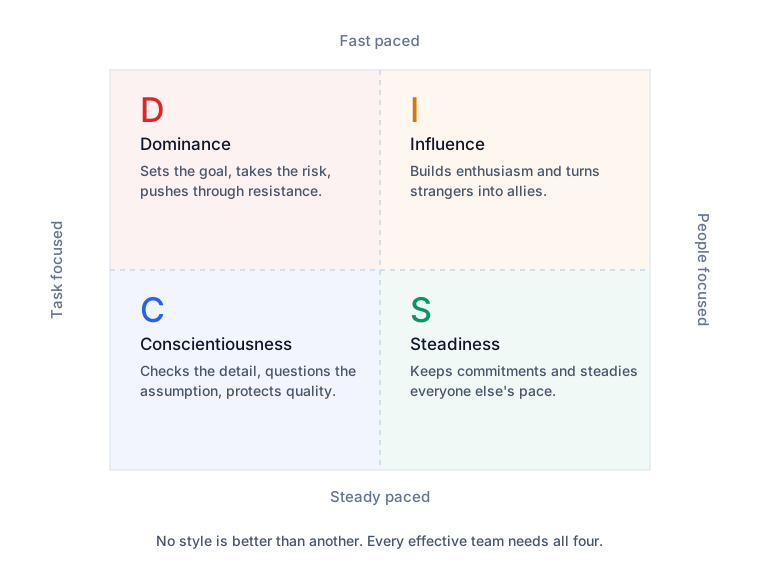
Two questions produce all of it: how fast you prefer to move, and whether your attention goes first to tasks or to people. Four styles, twelve blends, one wheel.
The short answer
What are the DISC personality types?
The DISC personality types are four styles of behaviour: Dominance (D), Influence (I), Steadiness (S) and Conscientiousness (C). Each is one answer to two questions, pace (fast or steady) and focus (task or people), and most people lead with one style and carry a close second, which makes a blend.
DISC describes how someone tends to act, especially at work. It does not measure ability, values or character, and no style is better than another.
D, I, S and C
The four DISC styles Each has its own page.
| Style | Pace and focus | In a sentence | The question it asks | Share of our takers |
|---|---|---|---|---|
| D personality type Dominance | Fast pace, task focus | Direct, decisive and driven by results. Sets the goal, takes the risk, pushes through resistance. | What are we trying to win? | 25.0% |
| I personality type Influence | Fast pace, people focus | Expressive, persuasive and optimistic. Generates energy and turns strangers into allies. | Who do we need on board? | 18.3% |
| S personality type Steadiness | Steady pace, people focus | Patient, supportive and consistent. Keeps commitments and notices when someone is struggling. | How do we keep this sustainable? | 20.0% |
| C personality type Conscientiousness | Steady pace, task focus | Precise, analytical and guided by standards. Checks the details and protects quality. | Is this actually correct? | 36.7% |
Shares are the primary style of the first 1,135 people to finish our assessment, not the general public. Method and full table.
Four, eight or twelve
Why DISC is drawn as a wheel
The four styles are not four boxes. They are four regions of a circle built from the two axes, and a result is a point on that circle. A DC near the task edge behaves differently from a DI leaning toward people, though both lead with D.
That is why the counts differ between sources. The model has four styles. The wheel is usually drawn with eight positions, the four styles and the four blends of neighbours. Counting every ordered pair of a first and a close second style gives twelve blends, including the less common pairs from opposite corners such as DS and IC.
On our assessment the single letter is reported when one score stands clear, and a two-letter blend when the runner-up sits within 0.4 of it on the 1 to 5 scale.
First letter leads, second colours it
The 12 DISC blends
A DI is a driver who persuades. An ID is a persuader who pushes. Same two styles, different person.
DI
The Pacesetter
Sets the goal first, then wins people to it. Persuasion in service of the result.
DC
The Finisher
Decisive and exacting. Moves fast, but only on a case that holds up.
DS
The Stalwart
Direct about the destination, patient with the people carrying things there.
ID
The Rainmaker
Leads with warmth and enthusiasm, and pushes without apology when the room stalls.
IS
The Connector
Sociable and loyal. Builds relationships quickly and keeps them for years.
IC
The Translator
Persuasive and precise. Checks the numbers before telling the story.
SI
The Host
Steady first, social second. Quiet consistency with genuine warmth on top.
SC
The Steward
Calm and careful. A dependable pace paired with a quiet insistence on getting it right.
SD
The Backbone
Patient by default, decisive when it counts. The steady hand that can still make the call.
CS
The Refiner
Precise and considerate. High standards delivered gently, without the sharp edges.
CD
The Standard-Bearer
Standards first, speed second. Analysis that ends in a decision, not a report.
CI
The Trusted Voice
Rigorous but expressive. Makes the careful answer easy for everyone to follow.
Our own data · 1,135 completed assessments
How common is each DISC style?
36.7%
Lead with C
25.0%
Lead with D
20.0%
Lead with S
18.3%
Lead with I
70.9% had a blend, and the most common single result was CS, The Refiner (13.8%). These are people who looked for a DISC assessment and finished it, so read them as our takers, not as everyone. See the full DISC statistics.
What it is for
Using the types well
01
For yourself
Name your default pace and focus, and the cost that travels with each strength. The free DISC assessment scores all four styles and places you on the wheel.
02
For a team
A shared vocabulary for everyday friction: who wants the summary first, who needs notice of change. A DISC assessment for team building puts everyone on one live map.
03
Never for selection
DISC describes how someone works, not how well. No DISC instrument, ours included, has published evidence that it predicts job performance, so it has no place in hiring or screening.
Common questions
DISC personality types: questions people ask
What are the 4 DISC personality types?
Dominance (D): fast-paced and task-focused, direct and decisive. Influence (I): fast-paced and people-focused, expressive and persuasive. Steadiness (S): steady-paced and people-focused, patient and supportive. Conscientiousness (C): steady-paced and task-focused, precise and analytical. Everyone uses all four; the type is the one reached for first.
Are there 4, 8 or 12 DISC types?
All three counts describe the same model at different zoom levels. There are four styles. The wheel is usually drawn with eight positions: the four styles and the four blends of neighbours (DI, IS, SC, CD). Counting every ordered pair of a first and a close second style gives twelve blends. Our report uses four styles and twelve blends, sixteen possible results in all.
Which DISC type is the best?
None. Each style supplies something a team needs and charges a cost when there is too much of it: D gives decisions and can cost notice, I gives energy and can cost follow-through, S gives reliability and can cost candour, C gives accuracy and can cost pace. DISC describes how someone works, never how well.
Can your DISC type change?
The primary style is fairly stable, and the detail moves. DISC describes behaviour in context, so a new role, a new manager or a hard quarter can shift a scale by a few points, which is enough to reorder a close second style. We have not published a test-retest figure for our instrument, so we do not quote one.
Is DISC scientifically valid?
It is a useful language with real limits. Its two axes resemble the interpersonal circumplex, a long-studied model in academic psychology, and studies comparing four-quadrant tools with the Big Five find sensible overlap. But DISC has far less peer-reviewed evidence than the Big Five, and nothing supports using it to select or screen people. Use it for communication and team conversations.
About this page
Michael Hodge, BSc Psychology (University of Wollongong), founder of SeeMyPersonality, wrote the 40 items in our DISC assessment and built the scoring behind the wheel. Research and review standards.
The four-style vocabulary comes from William Moulton Marston's 1928 book. Our assessment uses original statements and is not derived from, or affiliated with, any commercial DISC publisher.
Sources and further reading (5)
- Marston, W. M. (1928). Emotions of Normal People. The origin of the four-style vocabulary.
- Wiggins, J. S. (1979). A psychological taxonomy of trait-descriptive terms: the interpersonal domain. Journal of Personality and Social Psychology.
- Gurtman, M. B. (2009). Exploring personality with the interpersonal circumplex. Social and Personality Psychology Compass.
- McCrae, R. R. & Costa, P. T. (1989). The structure of interpersonal traits: Wiggins's circumplex and the five-factor model. Journal of Personality and Social Psychology.
- Jones, C. S. & Hartley, N. T. (2013). Comparing correlations between four-quadrant and five-factor personality assessments. American Journal of Business Education.
Start here
Reading about four styles is one thing. Seeing your own four scores is another.