What is DISC?
DISC is a model of everyday behaviour with four styles: Dominance, Influence, Steadiness and Conscientiousness. It comes from psychologist William Moulton Marston’s 1928 theory, and each style pairs two preferences: outgoing or reserved, and task-first or people-first.
A DISC assessment is a short self-report questionnaire that scores all four styles and shows where you sit on the DISC wheel. You can take the free DISC assessment in about 5 minutes.
By Michael Hodge, founder of SeeMyPersonality ·
The four letters
What does DISC stand for?
DISC stands for Dominance, Influence, Steadiness and Conscientiousness, the four DISC styles. Everyone uses all four; your style is the one you reach for first. Some publishers use other words for the same letters, such as Inspiring, Supportive and Cautious.
D
Dominance
Outgoing and task-oriented. Direct, decisive and driven by results: the person who makes the call while others are still circling it.
I
Influence
Outgoing and people-oriented. Expressive, persuasive and optimistic. Gets ideas moving by getting people to believe in them.
S
Steadiness
Reserved and people-oriented. Patient, supportive and consistent. Keeps commitments and notices when someone is struggling.
C
Conscientiousness
Reserved and task-oriented. Precise, analytical and guided by standards. Checks the figure everyone else waved through.
No style is better than another. Each supplies something a group needs, and each costs something when there is too much of it.
Choose any part of the wheel to read about it.
Big letters are the four styles. Two-letter codes are blends, written with the leading style first. Opposite styles meet near the centre.
Move a slider to see where you might sit.
Two sliders give a rough guess, not a score.
Get your real scores: take the free DISC assessmentShare of 1,135 people who chose to take SeeMyPersonality’s free DISC assessment (August to mid-September 2026) who got each result. A single letter means no close second. This is who took our assessment, not people in general. Exact ties for first place (7.9%) were assigned in D, I, S, C order. A further 4.2% had a balanced profile, with no style leading.
The model
What is the DISC model?
The DISC model places behaviour on two axes: outgoing to reserved, and task-oriented to people-oriented. D is outgoing and task-oriented, I is outgoing and people-oriented, S is reserved and people-oriented, and C is reserved and task-oriented. The corners shade into each other, so DISC is drawn as a wheel, and the SeeMyPersonality DISC assessment places each result as a point on it.
Outgoing or reserved? Outgoing styles (D and I) move fast, speak early and push for action. Reserved styles (S and C) listen first and think before they commit.
Task or people first? Task-oriented styles (D and C) look first at the goal and the facts. People-oriented styles (I and S) look first at relationships and who is affected.
The axes are older than the names. Marston asked whether a situation feels favourable or unfavourable, and whether you feel in control of it. Switch the wheel to 1928 to see his version of the same map.
Between neighbouring styles sit eight blends, written with the leading style first. Opposite styles, such as D and S, cancel out on both axes, so their four blends sit near the centre.
All 16 positions on the wheel, as a table
| Code | Name | Where it sits | Share |
|---|---|---|---|
| D | Dominance | Outgoing, task-oriented | 7.1% |
| DI | The Pacesetter | Between D and I, nearer D | 5.4% |
| ID | The Rainmaker | Between D and I, nearer I | 4.0% |
| I | Influence | Outgoing, people-oriented | 7.1% |
| IS | The Connector | Between I and S, nearer I | 2.8% |
| SI | The Host | Between I and S, nearer S | 1.4% |
| S | Steadiness | Reserved, people-oriented | 3.2% |
| SC | The Steward | Between S and C, nearer S | 12.4% |
| CS | The Refiner | Between S and C, nearer C | 13.8% |
| C | Conscientiousness | Reserved, task-oriented | 11.6% |
| CD | The Standard-Bearer | Between C and D, nearer C | 7.8% |
| DC | The Finisher | Between C and D, nearer D | 8.0% |
| DS | The Stalwart | Near the centre, toward D | 2.6% |
| SD | The Backbone | Near the centre, toward S | 2.0% |
| IC | The Translator | Near the centre, toward I | 3.5% |
| CI | The Trusted Voice | Near the centre, toward C | 2.8% |
Theory and history
Who created DISC theory? William Marston, 1928
DISC theory is psychologist William Moulton Marston’s 1928 idea that behaviour follows two judgements: does a situation feel favourable or unfavourable, and do I feel in control of it? His four answers were Dominance, Inducement, Submission and Compliance. Later writers kept the letters and renamed the last three Influence, Steadiness and Conscientiousness.
Marston set the theory out in Emotions of Normal People, a book that drew heavily on Olive Byrne’s doctoral research. He wrote about ordinary people, not patients, and never built an assessment or patented the idea.
Marston is also credited with the systolic blood pressure test that became one part of the polygraph, and in 1941 he created Wonder Woman.
From theory to assessment
- 1928Marston publishes Emotions of Normal People: four patterns, and no assessment.
- 1940s and 1950sIndustrial psychologist Walter Clarke builds an adjective checklist, drawing partly on Marston, to help employers choose staff.
- 1965Peter Merenda and Clarke publish Self Description, a version where you choose between words instead of ticking them.
- 1970sJohn Geier, a psychologist at the University of Minnesota, builds a DISC profile from that forced-choice test.
- TodayBecause nobody patented the theory, many organisations publish their own DISC assessment, each with its own statements and scoring.
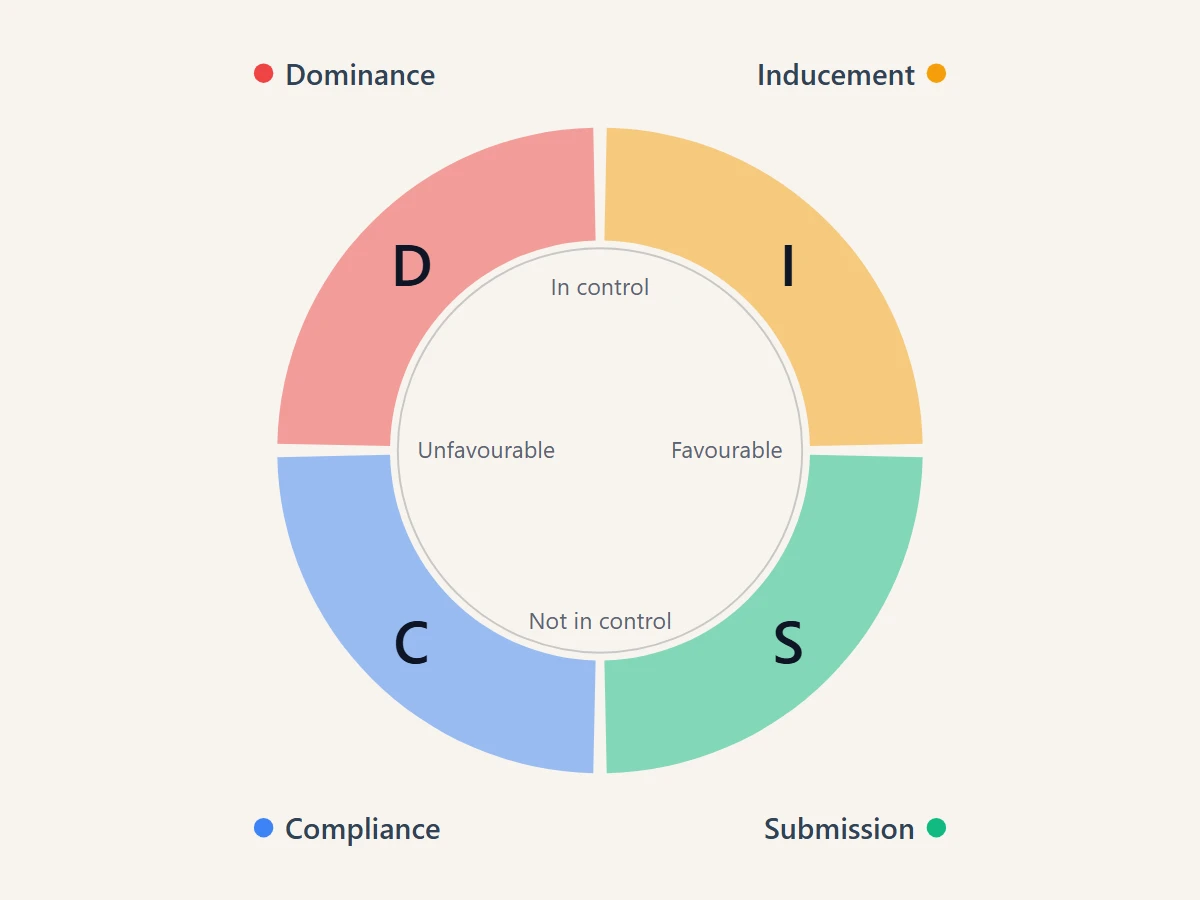
| Letter | Marston, 1928 | What he meant | Today |
|---|---|---|---|
| D | Dominance | Using force to overcome resistance | Dominance |
| I | Inducement | Using charm to deal with obstacles | Influence |
| S | Submission | Warmly and willingly going along with a request | Steadiness |
| C | Compliance | Adjusting, out of fear, to a stronger force | Conscientiousness |
The assessment
What is a DISC assessment, and what does it measure?
A DISC assessment, also called a DISC test or DISC profile, asks you to rate everyday statements about how you usually act. It turns your answers into a score for each of the four styles. The SeeMyPersonality DISC assessment then shows your main style, any close second and your place on the wheel.
What it measures
- Your habits of behaviour. How you tend to decide, talk, handle disagreement and react to change.
- Your mix of the four styles. A score for each, a main style and, often, a blend.
- How you see yourself. It is a self-report, so it can differ from what colleagues see.
What it doesn’t
- Ability or intelligence. A high D is not a better leader, and a high C is not cleverer.
- Values, character or mental health. DISC says nothing about whether someone is kind, honest or well.
- Job performance. DISC is not built to predict it, so it is not a hiring tool.
Treat your result as one input to a conversation, not a verdict. To see your own four scores, take the free DISC assessment.
Our data · n = 1,135
Why most DISC results have two letters
Few people sit deep in one corner. Most lead with one style and carry a close second, which DISC calls a blend.
36.1%
C · Conscientiousness
23.2%
D · Dominance
19.0%
S · Steadiness
17.4%
I · Influence
A blend is written with the leading style first. A DI is a driver who persuades; an ID is a persuader who pushes. Same two styles, a different person. All twelve are described in the 12 DISC blends.
On our assessment each style gets a score from 1 to 5. The highest is your main style, and a second letter is added when the runner-up is within 0.4 of it. If all four sit less than 0.4 apart, you get a balanced profile instead. The closer two scores are, the more both styles show in how you work.
Of those 1,135 people, 66.7% got a two-letter blend.
Among 1,135 people who chose to take SeeMyPersonality’s free DISC assessment between August and mid-September 2026, 36.1% had Conscientiousness as their main style, 23.2% Dominance, 19.0% Steadiness and 17.4% Influence. This describes who took our assessment, not people in general. A further 4.2% had a balanced profile, with no style leading. Exact ties for first place (7.9%) were assigned in D, I, S, C order. Method: how common each DISC style is.
Accuracy
Is DISC accurate?
DISC is accurate for what it is built to do: describe how people tend to behave at work and give a team a shared language for it. A result is clearest when one style stands well clear of the others. DISC is designed for understanding people, not for predicting how well they will do a job.
What DISC does well
- Its two axes look much like the interpersonal circumplex, a long-studied model of how people relate to each other.
- A 2001 study of one DISC assessment found its scores track the Big Five traits, the most researched model in personality psychology.
- Four styles are quick to learn and easy to remember, so teams keep using the language after a session.
What it is not for
- Measuring ability, intelligence or values.
- Choosing, ranking or screening job candidates.
- Comparing results across publishers: each writes its own statements and scoring.
For research into broad traits, psychologists use the Big Five personality test. For working together day to day, the four DISC styles are easier to share.
At work
How teams use DISC
DISC is most useful between people. It gives a team plain words for everyday friction: who wants the summary first, who needs notice of change, who goes quiet when they disagree.
A common way in is for everyone to take the assessment and put the results on one map. Gaps show quickly, such as plenty of drive and nobody checking the detail. Our DISC assessment for team building builds that map as people finish.
Short exercises then turn the map into habits, like sending a C the figures before the meeting. These DISC team building activities take 10 to 50 minutes each.
One rule holds throughout: DISC is for understanding each other, never for ranking, reviewing or selecting people.
Common questions
Questions people ask about DISC
What are the four DISC personality types?
The four DISC types are Dominance (outgoing and task-first), Influence (outgoing and people-first), Steadiness (reserved and people-first) and Conscientiousness (reserved and task-first). Most people lead with one and carry a close second. Each is covered in depth in the four DISC styles.
What does the I in DISC stand for?
The I in DISC stands for Influence: winning people over with enthusiasm and persuasion. Marston’s 1928 word for it was Inducement, which he described as using charm to deal with obstacles.
Why is the i in DISC sometimes lower case?
Some commercial DISC assessments print the i in lower case as part of their brand. It is the same style, Influence. Marston’s model and most other versions, including ours, write all four letters as capitals.
Is DISC a personality test?
Yes, in the broad sense: a DISC assessment is a self-report questionnaire about how you behave. It asks how you act and communicate rather than about broad traits, so it is narrower than the Big Five and easy to use at work.
How long does a DISC assessment take?
It varies by version. The SeeMyPersonality DISC assessment takes about 5 minutes and shows your four scores, your style and your place on the wheel when you finish.
How much does a DISC assessment cost?
DISC assessments range from free to paid, depending on the publisher and what comes with the report. Paid versions usually add facilitator material, group reports or workshops. The SeeMyPersonality DISC assessment is free, including the full report. The model itself is free to use, because Marston never patented it.
Can your DISC style change?
Yes, to a degree. DISC describes behaviour in context, so a new role or a demanding stretch at work can shift your scores, and a close second style can trade places with your first. Read your result as a tendency, not a fixed label.
Which DISC style is most common?
In our own data, Conscientiousness is the most common main style, followed by Dominance, Steadiness and Influence. Other publishers report different orders from different instruments and samples, so no single answer holds for everyone. The figures and method are in how common each DISC style is.
Can DISC be used for hiring?
DISC is built to help people understand how they and their colleagues work, not to predict job performance, so it should not be used to select, rank or screen candidates. It is most useful after hiring, to help a team work well together.
How is DISC different from the Big Five or the 16 types?
DISC is narrower than both: it describes working behaviour on two axes, so it is quick to share with a team. The Big Five measures five broad traits and is the most researched model. The 16 types sort people by four preference pairs.
What is DISC training?
DISC training is a session or course that teaches people to recognise the four styles and adapt how they communicate. It usually starts with everyone taking a DISC assessment, then uses short exercises such as these DISC team building activities. Some publishers also certify facilitators to run it.
About this page
Written by Michael Hodge, BSc Psychology (University of Wollongong), founder of SeeMyPersonality, who wrote the SeeMyPersonality DISC assessment. The assessment uses original statements and is not affiliated with any DISC publisher.
Sources (12)
- Marston, W. M. (1928). Emotions of Normal People.
- Wallace, S. R., Clarke, W. V. & Dry, R. J. (1956). The Activity Vector Analysis as a selector of life insurance salesmen. Personnel Psychology.
- Merenda, P. F. & Clarke, W. V. (1965). Self description and personality measurement. Journal of Clinical Psychology.
- Martinussen, M., Richardsen, A. M. & Vårum, H. W. (2001). Validation of an ipsative personality measure (DISCUS). Scandinavian Journal of Psychology.
- Wiggins, J. S. (1979). A psychological taxonomy of trait-descriptive terms: the interpersonal domain. Journal of Personality and Social Psychology.
- Gurtman, M. B. (2009). Exploring personality with the interpersonal circumplex. Social and Personality Psychology Compass.
- Wikipedia: DISC assessment (Marston’s four terms and two dimensions, no patent, Self Description and Geier).
- Wikipedia: William Moulton Marston (Olive Byrne’s research, systolic blood pressure test, Wonder Woman).
- Wikipedia: Activity vector analysis (Walter V. Clarke, 1942, drawing on Lecky, Marston and others).
- Wikipedia: John Geier (University of Minnesota psychologist).
- Wikipedia: Big Five personality traits.
- SeeMyPersonality DISC statistics: 1,135 completed assessments, 3 August to 18 September 2026.
Start here
See where you sit on the wheel.
Your four scores, how close your second style is, and what that means for working with others.